Blog

  • Honda CB1100R

    Honda CB1100R

    Honda CB1100RD
    Manufacturer Honda
    Production 1980-1983
    Predecessor Honda CB900F
    Successor Honda VF1000R
    Class Sport bike
    Engine 1,062 cc (64.8 cu in) air cooled inline 4, 4 stroke, DOHC, 16 valves
    Bore / stroke 70 mm × 69 mm (2.8 in × 2.7 in)
    Compression ratio 10.0:1
    Top speed 229 km/h (142 mph)
    Power 115 bhp (86 kW) @ 9000 rpm
    Torque 97 N⋅m (72 lbf⋅ft) @ 8000 rpm[citation needed]
    Ignition type Electronic
    Transmission 5 speed
    Frame type Tubular steel twin downtube
    Brakes Front: double 296 mm (11.7 in) disc
    Rear:single 296 mm (11.7 in)
    Tires Front: 100/90V18
    Rear 130/80V18
    Wheelbase 1,490 mm (59 in)
    Dimensions W: 805 mm (31.7 in)
    Weight 235 kg (518 lb) (dry)
    Fuel capacity 26 L (5.7 imp gal; 6.9 US gal)
    Related Honda CB1100F, Honda CB900F

    The Honda CB1100R was an exotic Honda model that was produced in limited numbers from 1980 to 1983. It was a single-seat sport bike based on the Honda CB900F, initially with a

    34 fairing and exposed lower engine. The R suffix denotes a racing version, however the CB1100R was a road-legal machine produced by Honda and offered for sale to the public. It was produced only in numbers sufficient to meet the homologation requirements for the R to be classed as a production motorcycle in markets into which it was sold. It was Honda’s first ‘homologation special’ and was raced in the production class racing in most major markets: including Europe, South Africa, Australia and New Zealand. It was not sold in the US.

    In 1980, the first batch of 110 naked versions were rushed to Australia specifically with the aim of winning the world renowned Castrol 6 Hour race. The Honda did indeed win with future world champion Wayne Gardner and Australian champion Andrew Johnson riding. The organisers of the event then prevented the single seat Honda from entering the 1981 Castrol 6 Hour as they deemed it a “race special”. In 1981, the CB1100R won the New Zealand Castrol Six Hour ridden by Australian pair of Malcolm Campbell and Mick Cole. The CB1100R was slightly modified to have a dual seat so as to reclassify it as a road bike, so allowing it to enter the 1982 Castrol 6 Hour, and duly won this premier Australian production race in 1982, the Castrol Six Hour in the hands of future 1987 500cc GP World Champion Wayne Gardner and teammate Wayne Clark. Other CB1100Rs finished the race 2nd, 3rd and 4th, with 6 CB11000Rs finishing in the top 8 spots. The Australasian success of the CB1100R lead directly to the development of the Suzuki GSX1100SXZ Katana homologation racing specials.

    The model designations are CB1100RB (1980 and 1981), CB1100RC (1982), and CB1100RD (1983). In 1980/81, 1050 units were sold, followed by 1500 per year in 1982 and 1983. The 1981 ‘RB’ was half faired with a solo seat only. The 82 and 83 models have different bodywork including a full fairing, aluminium fuel tank, and pillion seat covered with a removable seat cowl. The 82 (RC) and 83 (RD) were largely similar in appearance, yet with considerable differences what concerns the full fairing and dashboard layout. None of the fairing parts of any of the 3 models are interchangeable with one another. The RC fairing, fairing bracket and dashboard combo was only made for the RC and does not interchange in any way with the RD, which had a slightly shorter overall length. Other differences include the paint scheme, rear swing arm design and color and front fork design. In 1983 the Honda CB1100F was launched that essentially was a blend of the CB1100R and the CB900F, for a broader market. The 1981 CB1100RB had a claimed 115 hp (86 kW) @ 9000 rpm.

    Notes


  • Honda CB1100F

    Honda CB1100F
    Manufacturer Honda
    Production 1983
    Predecessor Honda CB900F
    Successor Honda CB1100
    Class Standard
    Engine Air-cooled inline 4-cyl, 4-stroke, double overhead camshafts (DOHC), four valves/cylinder
    Bore / stroke 70 mm × 69 mm
    Compression ratio 9.7:1
    Top speed 225 km/h (139 mph)[citation needed]
    Power 77 kW (108 hp) (limited to 73.5 kW, (100 hp) at 8500 rpm on European market)[citation needed]
    Torque 97 N⋅m/7500 rpm[citation needed]
    Ignition type Electronic
    Transmission 5 speed
    Frame type tubular frame
    Brakes double disc front, single rear
    Tires Front 100/90V18
    Rake, trail Rear 130/90V17
    Wheelbase 1520 mm
    Dimensions L: 2260 mm
    W: 805 mm
    H: 1125 mm
    Seat height 795 mm
    Weight 243 kg[citation needed] (dry)
    Fuel capacity 20 liter
    Related CB1100R, CB900F

    The Honda CB1100F is a standard motorcycle that was made only in 1983 by Honda, based on their line of DOHC air-cooled inline four engines. Honda introduced the similar CB1100 in 2010.

    History

    In 1979 Honda produced a double overhead cam (DOHC) 750 cc engine developing 72 bhp @ 9000 rpm which was used in the CB750F model in the US from 1979 to 1982. The same year Honda also released the CB900F using a race-bred 901 cc DOHC engine that was a step above the CB750 with its longer stroke and hotter cams squeezing out 95 bhp @ 8500 rpm (actual rear-wheel horsepower exceeded 80 horsepower as measured on a dynamometer).[citation needed] The CB900F was only offered in the US from 1980 to 1982.

    In 1983 Honda released the CB1100F, based on the CB900F and the CB1100R. Besides a distinctive-to-the-1100f paint scheme, it used hotter cams, larger pistons, better carburetion in the form of four Keihin 34 mm CV, and a redesigned combustion chamber. The CB1100F produced 108 bhp @ 8500 rpm. It also had increased rake and the dash featured a 150 mph or 240 km/h speedometer and adjustable two-piece handlebars. The tubeless-tire wheels were new also, 18-inch x 2.50-inch front and 17-inch x 3-inch rear. Performance was pace setting. Cycle World tests at 11.13 seconds/120.48 mph quarter mile and 141 mph half mile earned it the designation of “fastest stock bike ever tested”.

    The CB1100F was available in different markets, such as US, Canada, Europe, and Australia from 1982 through 1984. In the US, a quarter-fairing for wind deflection (and looks), and cast single piece wheels were offered. The other markets had not the fairing, and the wheels were gold “boomerang” Comstars, similar to the ones on the Honda CB1100R, and the control cables were routed above, rather than below, the handlebars. The riding position was more sporty than the US model, with rearset footpegs and controls as well as lower two-piece clip-on handlebars. These different parts were originally offered through US dealers as a complete sport, or “continental” kit, and now command a price premium in the US as owners seek to upgrade their machines.

    2010 CB1100

    2014 CB1100 at the Seattle International Motorcycle Show

    In 2007, Honda showed two new concepts: the CB1100R and the CB1100F. Both were highly reminiscent of the original CB1100F/R, even sporting dual rear shocks with remote fluid reservoirs. Honda showed a revised concept at the 2009 Tokyo Motor Show called the CB1100. It was shown in two variants. One being more standard while the other more ‘cafe-racer’ style (black exhaust, black fender, bikini fairing, tapered rear seat).

    In 2013, Honda began selling the air-cooled CB1100 in the US.

    References


  • Honda CB1100

    Honda CB1100
    Manufacturer Honda
    Production 2010–2022
    Assembly Japan
    Predecessor Honda CB1100F
    Class Standard
    Engine 1,140 cc (70 cu in) air- and oil-cooled 4-stroke 16-valve DOHC inline-four
    Bore / stroke 73.5 mm × 67.2 mm (2.9 in × 2.6 in)
    Compression ratio 9.5:1
    Top speed 130 miles per hour (210 km/h)
    Transmission 5-speed constant-mesh manual (2010–2013), 6-speed (2014–2022), chain-drive
    Frame type Steel double-cradle
    Suspension
    • Front: 41 mm (1.6 in) telescopic fork with adjustable spring preload, 107 mm (4.2 in) axle travel (standard/EX)
    • Rear: Swingarm, twin shock absorbers with adjustable spring preload, 114 mm (4.5 in) travel (standard/EX)
    Brakes
    • Front: Double 4-piston calipers with double 296 mm (11.7 in) discs (standard/EX)
    • Rear: Single-piston caliper with single 256 mm (10.1 in) disc (standard/EX)
    Wheelbase 1,485–1,490 mm (58.5–58.7 in)
    Dimensions L: 2,180–2,200 mm (85.8–86.6 in)
    W: 800–835 mm (31.5–32.9 in)
    H: 1,100–1,130 mm (43.3–44.5 in)
    Seat height 780–785 mm (30.7–30.9 in)
    Weight 240 kg (540 lb) (wet)
    Fuel capacity 16–17 L (3.5–3.7 imp gal; 4.2–4.5 US gal)

    The Honda CB1100 is a 1,140 cc (70 cu in) air-cooled inline four-cylinder naked bike that was introduced by Honda in 2010 as a modern spiritual successor to the original CB750. At introduction the motorbike was available in Japan, Australia and New Zealand; it was later introduced to Europe and the United States in 2013.

    The CB1100 is styled as a Universal Japanese Motorcycle. The model underwent a revision in 2014, gaining a sixth gear and new gauge cluster. Honda also released the CB1100 Deluxe, an upgraded variant on the standard CB1100. The 2017 model was updated with front and back LED lights, a new lighter exhaust, a seamless fuel tank made of pressed aluminum, and the addition of a slipper clutch.

    The CB1100 ended production in 2022.

    CB1100 Deluxe/EX

    Honda CB1100 EX

    Introduced in 2014 the Deluxe model has a 6 speed transmission, larger fuel tank (extra 0.7 gallons), 4-in-2 exhaust, ABS, modified seat and other details. In North America this model is labeled CB1100 DLX.

    The CB1100 EX model variant in addition to the DLX also features wire wheels. As of 2014 it is available in Japan and Europe.

    CB1100 RS

    Honda CB1100 RS

    The sports-oriented CB1100 RS model was released in the 2017 model year. This model has all lighting from LED lights, slightly revised engine, 17-inch aluminium wheels, shorter wheelbase by 5 mm, Tokico radial brake calipers, different caster angle, sportier suspension setup with dual bending valve two-piece Showa 43 mm fork, and sport-oriented tires.

    References


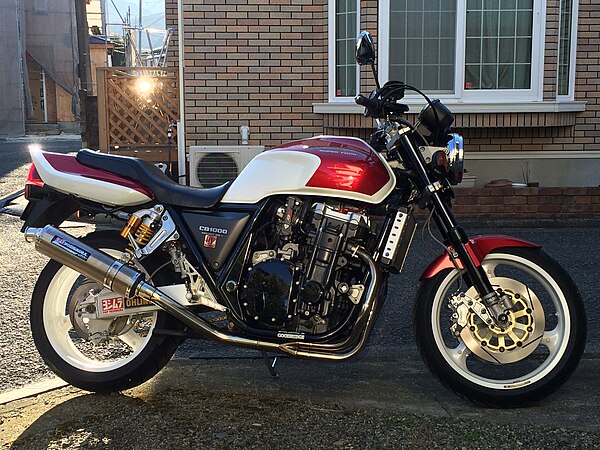
  • Honda CB1000R

    Honda CB1000R

    2021 Honda CB1000R SC80
    Manufacturer Honda
    Production
    • 2008–2016 (SC60)
    • 2018–present (SC80)
    Predecessor Honda CB900F
    Class
    • Standard
    • Naked bike
    CB 1000R (SC60)

    The Honda CB1000R is a CB series 1,000 cc (61 cu in) four-cylinder standard or naked motorcycle made by Honda from 2008 to 2016, and resumed from 2018.

    History

    It was unveiled at EICMA November 2007 as a replacement for the CB900F Hornet, the US-market’s 919.

    The CB1000R’s styling cues are borrowed from the 2007 CB600F Hornet. The engine is a detuned version of the 2007 CBR1000RR engine, and produces about 81.61 kW (109.44 hp) at the rear wheel. The front suspension uses a 43 mm (1.7 in) inverted HMAS cartridge-type telescopic fork with stepless preload with compression/rebound adjustments and 110 mm (4.3 in) travel. The rear is a monoshock with gas-charged HMAS damper with 10-step preload and stepless rebound damping adjustment and 130 mm (5.0 in) axle travel.

    In November 2017, Honda unveiled the new iteration of the CB1000R, along with the CB125R and CB300R. The bike uses a new styling direction dubbed as Neo Sports Café. This design language has been applied before to the CB150R ExMotion and then applied to the CB650R, the successor of the CB650F.

    Specifications

    2008-2016 (SC60) 2018-present (SC80)
    Engine 998 cc (60.9 cu in) liquid-cooled 4-stroke 16-valve DOHC inline-four
    Bore/stroke 75 mm × 56.5 mm (2.95 in × 2.22 in)
    Compression ratio 11.2:1 11.6:1
    Power 92 kW (123 hp)/10,000rpm (claimed)
    81.61 kW (109.44 hp) (tested)
    107 kW (143 hp)/10,500rpm (claimed)
    Torque 99 N⋅m (73 lb⋅ft)/7,750rpm (claimed)
    87.38 N⋅m (64.45 lbf⋅ft)
    104 N⋅m (77 lb⋅ft)/8,250rpm(claimed)
    Fuel Tank 16.2 L (3.6 imp gal; 4.3 US gal)
    Transmission 6-speed
    Frame Mono-backbone cast aluminum Mono-backbone steel
    Front suspension Inverted 43 mm (1.7 in) telescopic fork 43 mm (1.7 in) Showa SFF-BP fork with spring preload, rebound and compression damping adjustability
    Rear suspension Single-sided swingarm, monoshock 128mm axle travel Single-sided swingarm, monoshock 131mm axle travel
    Front Brakes 2 × 310 mm (12 in) disc, radial 4-piston calipers
    Rear brakes 256 mm (10.1 in) disc
    Tires Front: 120/70–17
    Rear: 180/55–17
    Front: 120/70/17
    Rear: 190/55-17
    Rake/trail 25°, 98.7 mm (3.89 in) 25°, 100 mm (3.9 in)
    Wheelbase 1,445 mm (56.9 in) 1,455 mm (57.3 in)
    Length 2,105 mm (82.9 in) 2,120 mm (83 in)
    Width 805 mm (31.7 in) 789 mm (31.1 in)
    Height 1,095 mm (43.1 in) 1,090 mm (43 in)
    Seat height 825 mm (32.5 in) 830 mm (33 in)
    Kerb weight 217 kg (478 lb)
    ABS:222 kg (489 lb)
    212 kg (467 lb)

    References

    • A new version of the CB1000R was launched in 2021 called the Black Edition, featuring several updates


  • Honda CB900C

    CB900C

    1981 CB900C
    Manufacturer Honda
    Predecessor CB900
    Successor CB1000C
    Engine 902 cc (55.0 cu in) 16-valve, DOHC air-cooled inline-4
    4 carburetors
    Top speed 124 mph (200 km/h)
    Transmission 5-speed (dual ratio giving 10 speeds) manual, shaft drive
    Suspension Front: Telescopic fork
    Rear: Twin shock
    Brakes Front: 2× disc brakes
    Rear: Disc
    Weight 259 kg (571 lb)[citation needed] (dry)
    277 kg (611 lb)[citation needed] (wet)
    Fuel consumption 42 mpg‑US (5.6 L/100 km; 50 mpg‑imp)
    Related CB750K, CB900F, CB1100F

    The Honda CB900C is a cruiser motorcycle produced by Honda from 1980 to 1982 primarily for the American market. It was succeeded by the CB1000C in 1983.

    Design

    The CB900c had a front and rear air assisted suspension, shaft drive, and a dual-range sub-transmission. The CB900C was derived from the DOHC CB750K, and is closely related to the CB900F and the 1983-only CB1100F, both derivatives of the CB750 line.

    The air/oil cooled DOHC 902 cc (55.0 cu in) engine has 4 32 mm Keihin CV carburetors and electronic ignition. The front suspension relies on air pressure for preload while the rear uses air as the main springing medium. The bike has two front disc brakes and a single rear disc.

    The CB900C is something of a “parts bin” bike, as it shares components with two contemporary Honda bikes, the CB750 and CB900F. The GL and CX series of touring motorcycles of the time are the source of the final drive and rear suspension assemblies of the CB900C. The frame was derived from the European CB900F, extended 2 inches to accommodate the sub-transmission components. The sub-transmission involves a jack shaft that allows the rider to select a “high” or “low” range for the five gears, effectively giving an overdrive 6th speed for cruising.

    Full Honda accessories, (fairings, lower leg fairings, saddlebags and trunk) were available to help make the CB900C a touring motorcycle.

    Reception

    The Rider and Cycle World reviews of 1980 were less than enthusiastic, complaining of “a lack of purity in the custom styling”. The excessive weight and the soft suspension had a detrimental effect on handling and on cornering ability. Despite the lacklustre reviews, the CB900 Custom has gained a small cult following due to its 10 speeds, styling, comfort, reliability, and ample power output.

    1983 CB1000C (Custom)

    In 1983, Honda replaced the CB900C with the CB1000C. The CB1000C used the dual-range transmission previously available on the CB900C. The 978 cc (59.7 cu in) version included the TRAC anti-dive system also used on the 1983 CB1100F.

    References


  • Honda CB1000

    Honda CB1000 Super Four
    Manufacturer Honda
    Production 1992–1998
    Assembly Japan
    Successor Honda CB1300 Super Four
    Class Standard
    Engine 998 cc (60.9 cu in) liquid-cooled 4-stroke 16-valve DOHC inline-four
    Bore / stroke 77.0 mm × 53.6 mm (3.0 in × 2.1 in)
    Compression ratio 10.0:1
    Top speed
    • 222 km/h (138 mph)
    • 206 km/h (128 mph)
    Power
    • 72.9 kW (97.7 hp) @ 8,250 rpm
    • 71.2 kW (95.5 hp) @ 8,500 rpm
    Torque
    • 89.5 N⋅m (66.0 lb⋅ft) @ 5,750 rpm
    • 84.6 N⋅m (62.4 lb⋅ft) @ 6,000 rpm
    Frame type Steel double-cradle
    Brakes
    • Front: Axially-mounted double 2-piston Nissin calipers with double 310 mm (12.2 in) discs
    • Rear: Single-piston Nissin caliper with single 276 mm (10.9 in) disc
    Rake, trail 24°, 99 mm (3.9 in)
    Wheelbase 1,540 mm (60.6 in)
    Dimensions L: 2,220 mm (87.4 in)
    W: 785 mm (30.9 in)
    H: 1,130 mm (44.5 in)
    Seat height 790 mm (31.1 in)
    Weight 246 kg (542 lb) (dry)
    262 kg (578 lb) (wet)
    Fuel capacity 22 L (4.8 imp gal; 5.8 US gal)
    Fuel consumption 6.9 L/100 km (41 mpg‑imp; 34 mpg‑US)

    The SC30 Honda CB1000 is a CB series standard motorcycle made by Honda from 1992 to 1996. Nicknamed “The Big One”, it utilized a DOHC 998 cc (60.9 cu in) inline four, which was derived from the CBR1000F. It was briefly sold in the US from 1994 and 1995.

    Notes

    References


  • Honda CB-1

    Honda CB-1
    Manufacturer Honda
    Also called CB400F, NC27
    Production 1989–1990
    Predecessor Honda CBX400F
    Successor Honda CB400SF
    Class Naked bike
    Engine 399 cc (24.3 cu in) liquid cooled DOHC four valves/cyl. inline-four
    Bore / stroke 55.0 mm × 42.0 mm (2.17 in × 1.65 in)
    Compression ratio 11.3:1
    Top speed 190 km/h (118 mph)
    Power 55.2 bhp (41.2 kW) @ 10,000 rpm (claimed)
    Torque 29 lb⋅ft (39 N⋅m) @ 9,500 rpm (claimed)
    Ignition type electric starter
    Transmission 6-speed chain drive manual
    Frame type Steel perimeter
    Suspension Showa. Front: 41 mm telescopic fork, non-adj.
    Rear: single shock w/7-way preload adj.
    Brakes Single disc front/rear
    Tires Bridgestone Front: 110/70-17
    Rear: 140/70-17
    Rake, trail 25.5 degrees, 99 mm (3.9 in)
    Wheelbase 1,370 mm (54 in)
    Dimensions L: 2,035 mm (80.1 in)
    W: 705 mm (27.8 in)
    Seat height 775 mm (30.5 in)
    Weight 179 kg (395 lb) (dry)
    187 kg (413 lb) (wet)
    Fuel capacity 3.3 US gal (12 L; 2.7 imp gal)
    Related Honda CBR400

    The Honda CB-1 is a small, light naked sports motorcycle with a 399-cubic-centimetre (24.3 cu in) straight-four engine, carrying the model code NC27. In contrast to other models of the Honda CB series, the name is written with a hyphen. In some countries it was marketed as Honda CB400F.

    The bike was first introduced in 1989 and continued through 1990. Originally developed for the Japanese market, the CB-1 was also available in the United States and Canada. Called a “great motorcycle that never found an audience” and “victims of a difficult market” by Cycle World, the final model year 1990 CB-1s available as leftover stock were offered in 1992 at a $600 discount, for $3700 in the US, which in current money would be $8,291 accounting for inflation.

    The CB-1 engine is similar to the early NC23 models CBR400RR, with changes to the port lengths and angles as well as smaller valves and lower compression ratio; changes in the primary and secondary gear ratios reduced the 60 mph (97 km/h) first gear down to around 30 mph (48 km/h), making the slightly less powerful CB-1 feel much quicker from a standstill than its sportier sibling, All engines derived from the NC23 block carry the NC23 ID code in the engine number; this includes the NC27, 23, 29, 31 etc., including the VTEC models with chain driven cams. Like many of its stablemates, the CB-1 has straight gear-driven dual camshafts with self-silencing gears to reduce whine.

    Cycle World measured the time to cover a

    14 mile (0.40 km) as 13.17 seconds with a final speed of 99.16 miles per hour (159.58 km/h) and the top speed as 118 miles per hour (190 km/h) Braking distance from 60 to 0 miles per hour (97 to 0 km/h) was 124 feet (38 m). — saying the bike was “a reincarnation of the standard motorcycle … the sort of bike everyone rode before sporting riders went replica racer crazy”.

    References


  • Honda C92, CB92, C95 Benly

    1963 Honda C92 125cc Benly

    The Honda C92 Benly is a 125 cc (7.6 cu in) parallel-twin motorcycle made by Honda from 1959 through 1965. Running concurrently were the CB92 Sports and the slightly larger C95 150 cc (9.2 cu in), called the CA92 and CA95 in the US. These twins took their styling and design cues from the larger-displacement Honda C71, C76, C72, C77 Dream series.

    A separate model, the Honda CD125TC Benly, was sold under the Benly name in the United Kingdom from 1982 to 1985. The Benly name was revived in 2011 for a line of commercial scooters sold in Japan.

    Description

    The name Benly comes from the Japanese word benri (Japanese: ベンリィ, meaning convenient).

    The frame was a pressed-steel, fully-welded design with the front end carrying the steering head and the rear end forming the deeply valanced mudguard. The front forks were pressed steel and carried the front mudguard. Front suspension was of the leading link type. Rear suspension was by fully enclosed telescopic dampers. Front and rear brakes were six-inch single-leading-shoe type in full-width hubs. Wheels were 16-inch.

    The engine was a straight- or parallel-twin, four stroke with two valves per cylinder operated by a chain-driven overhead camshaft. The compression ratio of the C92 was 8.3:1, and the C95’s was 9.7:1. Honda’s claimed horsepower for the C92 was 11.5 hp (8.6 kW) @ 9,500 rpm and 16.5 hp (12.3 kW) @ 10,000 rpm for the C95. The claimed torque was 0.9 kg⋅m (8.8 N⋅m; 6.5 lb⋅ft) @ 8,200 rpm for the C92 and 1.25 kg⋅m (12.3 N⋅m; 9.0 lb⋅ft) @ 9,000 rpm for the C95. They had a 10.1 L (2.2 imp gal; 2.7 US gal) fuel tanks, and single 18 mm (C92) or 20 mm (C95) carburettors. The primary drive was by helical-cut gears to a multi-plate clutch running in oil which lubricated both the engine and the four-speed gearbox, and a fully enclosed chain final drive. The electrical system was six volts on early models, 12 volt on later models and an electric starter was a standard fitment on all models.

    C92 and C95

    Honda CB92 125cc

    Cosmetically, the C92 and C95 (called CA92 and CA95 in the US) differed mainly in their handlebars. The European bikes had flat pressed steel bars and the American bikes had raised tubular bars but when the C95 was brought to Europe, it was equipped with the raised tubular bars. There was also a CS92 which had a high-level scrambler style exhaust system.

    The Honda CB92 is the lineup’s super sports model. Cosmetically, it had briefer mudguards made with aluminium and small chain-guard. The fuel tank was larger, bearing resemblance to the prototype CB71 and CE71 tanks,while holding 10.5 litres (2.3 imp gal). The rear suspension had exposed springs. Both hubs were 8 inch magnesium not shared with other models. Its braking were by drum brakes with the front being a twin-leading-shoe type. Both wheels were 18 inch. The engine had higher compression pistons of 10:1. Early engine blocks were iron while later models changed to aluminium. Quoted HP/rpm was 15/10,500 and torque in kg.m/rpm was 1.06/9,000. The crankshaft of the CB92 was supported by three main bearings instead of two in the standard engine.

    Commercial scooters (2011–present)

    Benly Pro

    In September 2011, Honda released the Benly and Benly Pro (model JBH-AA03), 50 cc-class scooters intended for commercial use. They are imported to Japan from Guangzhou, where they are assembled under the Wuyang Honda brand. The Pro model is equipped with a foot pedal for the brake and a front basket. Both models used the AA03E, an air-cooled four-stroke single-cylinder engine with a maximum output of 2.8 kW (3.8 hp) (at 8250 RPM) and 3.5 N⋅m (2.6 lbf⋅ft) (at 6500 RPM). Both models were rated with a fuel consumption rating of 66.0 km/L (186 mpg‑imp; 155 mpg‑US) at a steady 30 km/h (19 mph) and included 10 L (2.2 imp gal; 2.6 US gal) fuel tank. They included an automatic transmission and were designed with a low cargo area and seat height for convenience.

    Benly 110 used by police force of Saitama Prefecture

    They were supplemented by the Benly 110 and Benly 110 Pro (model EBJ-JA09) in January 2012, which were equipped with a larger, more powerful JA09E engine and were capable of carrying a higher cargo weight. The JA09E displaced 107 cc (6.5 cu in) and had a maximum output of 5.8 kW (7.8 hp) at 7000 RPM and 8.6 N⋅m (6.3 lbf⋅ft) at 5000 RPM, giving the scooters a fuel consumption rate of 53.0 km/L (150 mpg‑imp; 125 mpg‑US) at a steady 60 km/h (37 mph).

    In 2015, the Benly and Benly Pro (model JBH-AA05) were updated with the AA05E, a water-cooled single-cylinder engine with a maximum output of 3.2 kW (4.3 hp) (at 7750 RPM) and 4.2 N⋅m (3.1 lbf⋅ft) (at 6000 RPM) and fuel consumption of 65.2 km/L (184 mpg‑imp; 153 mpg‑US) at a steady 30 km/h (19 mph). The Benly 110 and 110 Pro continued with slight changes to improve maintainability. Second generations of the Benly/Pro (2BH-AA05) and the Benly 110/110 Pro (2BJ-JA09) were launched in late 2017 to meet new emissions standards. Benly 110 production was discontinued in October 2022 to comply with 2020 emission regulations.

    Benly e: I Pro

    Honda launched the Benly e: line in December 2019, available in four different models:

    • Benly e: I (Model ZAD-EF07, corresponding to Benly)
    • Benly e: I Pro (ZAD-EF08, similar to Benly Pro)
    • Benly e: II (ZAD-EF10, Benly 110)
    • Benly e: II Pro (ZAD-EF11, Benly 110 Pro)

    The Benly e: I models are equipped with the EF07M AC synchronous traction motor, which has a peak output of 2.8 kW (3.8 hp) at 3000 RPM and 13 N⋅m (9.6 lbf⋅ft) at 2000 RPM and a continuous output of 0.58 kW (0.78 hp). They are equipped with two Honda Mobile Power Pack (MPP) removable lithium-ion batteries, giving these scooters an estimated range of 87 km (54 mi) at a steady 30 km/h (19 mph). The Benly e: II models are equipped with a more powerful EF10M traction motor, which has a peak output of 4.2 kW (5.6 hp) at 3900 RPM and 15 N⋅m (11 lbf⋅ft) at 1500 RPM and a continuous output of 0.98 kW (1.31 hp). The estimated range of the Benly e: II models is 43 km (27 mi) at a steady 60 km/h (37 mph).

    See also

    • List of motorcycles of the 1950s

    References


  • Honda C71, C76, C72, C77 Dream

    1962 Honda CA72 250cc Dream “early model”

    The 250 cc (15 cu in) Honda C71 and C72 Dream, and the identical C76 and C77 bikes with 305 cc (18.6 cu in) displacement, were the first larger-capacity motorcycles that Honda mass-exported. They were characterised by a pressed steel frame and alloy overhead cam, twin-cylinder engine, and were very well equipped, with 12 volt electrics, electric starter, indicators, dual seats and other advanced features not common to most motorcycles of the period.

    History

    These bikes started out as the Honda C70 Dream. Soichiro Honda had dubbed many of his earlier bikes ‘Dream’ after his dream of building complete motorcycles.

    1950s

    1958 Honda CS71

    The C70 was a 250cc pressed-frame motorcycle, with a very similar frame to later machines, released in 1956. It was usually seen with a single seat and rack, with clip-on pillion pad.

    The C75 was the 305cc version of the C70. It had a square head-light and shock absorbers, leading link forks, pressed-steel handlebars and were somewhat unusual in appearance. The engine was dry sumped, and had six-volt electrics. The design of both the frame and engine was heavily influenced by bikes built by NSU Motorenwerke AG, which Soichiro Honda had seen on his visit to Europe in 1955, including the Isle of Man TT races.

    The C71 and C76 were later developments, from 1957 or 1958 onwards. The C71 was the 250cc bike, while the C76 was 305cc. Not much had changed visually, but they were fitted with electric starters. Dual seats were common on export bikes, but the single seat/rack combination was available. They were exported to Europe and the US, and other markets. A C71 was shown in the Netherlands in 1958, and shown at the Earls Court show in either 1958 or 1959, while the C76 became the flagship bike for the Honda range released into the US in 1959.

    There was a version specifically built for the US market called the CA76, which came equipped with conventional tubular handlebars, although the standard pressed-steel bar C71 and C76 were also sold in the US. In the end, only a small handful were exported around the world. These were the first of the Honda ‘Dreams’ sold outside Japan. Also available was the ‘Dream Sport’ bikes with high exhaust pipes, the CS71/CS76 and CSA71/CSA76. All sold well in their home market, and have attained cult-status amongst Japanese collectors.

    The CE71 Dream Sport is a closely related version, and very rare. The dry-sumped engine, in the same pressed frame, with tubular handlebars, low sports exhaust pipes and dual seat, with an angular fuel tank similar to the CB92. They were exported to the US and Europe. Just over 400 were made and they were all recalled, with most scrapped.

    Another rare version was the CB71 – another sports version of the dry sump bikes. It was only available in Japan, and it only in limited numbers. It was very reminiscent of the CB92 – pressed frame, flat ‘ace’ handlebars, fly screen, low megaphone exhaustpipes, cut down rear mudguard, cycle-style front guard, angular fueltank with the ‘wrap-over’ rubber kneepad of the CB92.

    1960s

    Honda C77 Dream
    1964 Honda CA77

    The final development of these bikes, the C72/C77, was available from 1960. A 1960 C72/C77 would be a very rare bike; most came out in 1961. The American market CA72/CA77 was available in 1961. These bikes were made until 1967, although it seems that because of the way US bikes are dated, many are referred to in the US as 1968 or even 1969 models. These bikes saw a completely redesigned engine: a wet-sump design with many internal differences, essentially a new motor, with electric start and 12v system.

    The C72 and C77 had pressed steel handlebars, while the CA72 and CA77 had high tubular bars. Beyond that there were only minor differences, different indicators were fitted to the non-US bikes to suit the countries laws. Bikes built up to 1963 had a different fuel tank shape to later bikes, and the pressed steel bars were discontinued at about the same time (all models using conventional tubular bars) but otherwise the bike stayed much the same for the rest of its run. There was also a version of the bike called the C78/CA78, but visually there were no substantial differences to the C77/CA77.

    Pre-1963 CA77s were considered as well-equipped touring/commuter bikes — not particularly sporting, but reliable and comfortable, with a turn of speed much better than many larger-capacity bikes. Like the earlier dry-sump bikes, there were high-exhaust sports version, the CS72 and CS77, and the corresponding American market CSA72 and CSA77.

    The C72/C77 was exported to Europe, Britain, Australia and other markets, and sold in some numbers, although as it was comparatively expensive, not as well as hoped. Post-WW2 anti-Japanese sentiment was still rife, and in the UK, manufacturers like BSA and Triumph attempted to convince dealers not to sell Japanese bikes. Also, the style was considered to be somewhat unusual to European eyes, and by the mid-1960s quite old-fashioned.

    Legacy and influence

    A re-development of the engine was used in the seminal CB72 and its 305cc cousin, the CB77, both of which were ground-breaking sports motorcycles of their day. The CL72 and CL77 Scramblers also used the same engines. In addition, the engine was studied, and developed and enlarged by the Laverda factory as the basis of their 650cc and 750cc twin cylinder engines.

    These days, these Honda models are considered collectibles, and have a strong following in the Vintage Japanese Motorcycle Club.

    See also

    • List of motorcycles of the 1950s

    References


  • Honda Bravo

    Honda Bravo

    Honda Bravo
    Manufacturer Honda
    Production 2006–present
    Class Underbone
    Engine 100 cc (6.1 cu in), four-stroke, OHC, air-cooled, single
    Transmission 4-speed rotary type
    Brakes Front: drum
    Rear: drum
    Seat height 764 mm (30.1 in)
    Weight 89 kg (196 lb)[citation needed] (dry)
    Fuel capacity 3.7 L (0.81 imp gal; 0.98 US gal)
    Related Honda XRM

    The Honda Bravo is a four-stroke 100 cc (6.1 cu in) underbone class motorcycle designed and manufactured in the Philippines. The frame and engine of the Honda Bravo is the same as the Honda Wave 100 of Thailand, and they differ only in the plastic body fairings. This motorcycle is related to the Honda XRM, which is also designed and manufactured in the Philippines. It uses an aluminium engine.

    References

    • Honda Philippines Bravo Website