The Honda Z50A is a small motorcycle with a 49 cc (3.0 cu in) single-cylinder four-stroke overhead cam engine and a semi-automatic transmission. It was made by Honda from 1968 to 1978 and it was the second generation of the Z50 series of minibikes.
Z50A designs
The 1968-1971 Z50As were known as the “Hard Tail” because of their lack of rear shock absorbers. 1968 was also called a K0, a 1969-1970 is called a K1 and a 1970-71 are referred to as K2s. Rear shock absorbers were added to the Z50A in 1972 and it was referred to as a K3.
History
The 1968 sometimes referred to as the “High Bar” or the “Slantguard”, was the first of the Z50 series to be released to the American market. The bikes had white handgrips and 8 inch wheels. They came in with a two tone paint job.
In 1969, Honda released the K1 which added street legal lighting. Lower handlebars were fitted on the 1969/1970 K1 “short tail” as well as a license plate mount.
In 1972, after frame cracking became a growing issue, Honda incorporated rear suspension on the bike. The Z50A “Soft Tail” remained on the American market until after model year 1978, when it was replaced by the Z50R. In Europe and Japan, the Z50A was renamed the Z50J in 1973, and remained on the market until 1999.
The Honda XR series is a range of four-stroke off-road motorcycles that were designed in Japan but assembled all over the world.
Some of the XR series came in two versions: R and L. The R version bikes were enduro machines designed for off-road competitive riding. They were fitted with knobby off-road tires and were not always street legal. The L version models were dual-sport trailbikes, fitted with lights, indicators, horn, and street-legal tires.
Small XR models
XR80
Small XR models include the XR50R, XR70R, XR75R, XR80R and XR100R. They are much smaller in size in comparison to the other bikes in the series, and are designed for children, smaller riders, as pit bikes, or for recreational fun.
The XR80R was used in the film Terminator 2: Judgment Day, ridden by a young John Connor ( Edward Furlong ). In some scenes the taller XR100R (VIN H2HE0309LK900900) is the motorcycle from those sequences was used as Furlong’s stunt double was an adult man. The sound effects are that of a two-stroke engine for dramatic effect.[failed verification – see discussion]
The XR50 is a small four-stroke 50 cc (3.1 cu in) child’s entry level motorcycle, introduced in 1969 and still in production as the CRF50 in 2021. Originally it was called the Z-50, then Trail-50, the XR 50, CRF 50, and the mini dirt bike.
XR100R
2001 Honda XR100R
Main article: Honda XR100R
The XR100R was first introduced with the R designation in 1985, four years after the XR100 was brought to market. A major difference between the two was a major rear suspension upgrade to a more race-like single coil-over design (monoshock) and a new swingarm over the traditional dual real coil-over systems on the XR100. This suspension system was known as the Pro-Link system on Hondas.
XR 125L
2003 Honda XR 125 L
In some markets[which?], an XR125L was released in 2003. The 124 cc (7.6 cu in) engine generates 11.52 hp (8.59 kW) at 4,500&;rpm, Only the 2010 XR125L has a kick starter.
The XR 125L shares the same basic engine (JC30E) as the Honda CG125ES but with a few differences (the XR125L variant of the JC30E engine has larger diameter mounting holes in the engine casing, an engine mount on the cylinder head, and a longer counter shaft in the transmission to support wider rear wheels), and produces a maximum torque of 7 ft-lb, the top speed in real world conditions is between 55 and 60 mph (89 and 97 km/h) with a fuel consumption of about 60 mpg‑US (3.9 L/100 km; 72 mpg‑imp).[citation needed]
In Brazil, this model was named NXR 125 Bros.
XR 150L
The XR 150L was released in 2014. The 150cc 4-stroke, single-cylinder, air-cooled, OHC engine generates 12.14 hp (9.05 kW) at 7,750&;rpm, Electric and kick starter.
The XR 150 produces maximum torque of 12.5Nm at 6000 rpm; the top speed in real world conditions is between 60 and 68 mph (97 and 109 km/h) with a fuel consumption of about 60 mpg‑US (3.9 L/100 km; 72 mpg‑imp). It has a 5-speed gearbox. It has 19 in (480 mm) front wheel and 17 in (430 mm) rear wheel. It has a 12-litre fuel tank and luggage rack as standard. In many countries it can be road-registered but not Australia. Curb weight is 130 kg. It has a front disc brake and rear drum brake.[citation needed] A more recent version is the 2023 XR150L released in early 2023 for $2971 new. It has a four stroke engine, long travel suspension, and an electric starter.
XR 190L
The XR 190L was released in 2019. The 184.4 cc (11.25 cu in) engine 4-stroke, single-cylinder, air-cooled, OHC fuel-injected engine generates 15.6 hp (11.6 kW) at 8,500rpm, Electric and kick starter.
The XR 190L produces Max torque of 15.6Nm @ 6000 RPM, the top speed in real world conditions is between 65–72 mph (105–116 km/h) with a fuel consumption of about 60 mpg‑US (3.9 L/100 km; 72 mpg‑imp). Other than the larger engine capacity over the XR150L, the XR190L has Fuel Injection. It has a 5 speed gearbox. It has 21 inch front wheel and 18 inch rear wheel. It has a 12-litre fuel tank and luggage rack as standard. In many countries it can be road registered including Australia. Kerb weight is 137 kg. It has a front disc brake and rear drum brake. In some international markets, there is an agricultural version of the XR19L, rebadged to be a XR190AG aimed at farmers for Australia and New Zealand with additional racks and lowered gearing. [citation needed]
A derivative for South America, named XRE 190, has electric start only, and disc brakes featuring single-channel ABS on the front wheel.
XR 200
1980 XR200
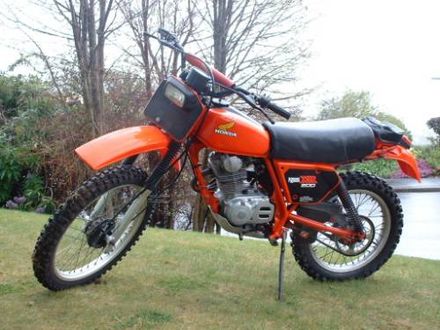
The XR200, a development of the XL185 trail bike, was produced from 1980 until 1984. The XR200 had a modestly enlarged ohc 2-valve 6-speed air-cooled engine with kick-start only. Suspension was conventional, like the XL185s, but with better quality components and more travel. Although the XR200 power output was modest, the bike was small and light and it suited less experienced riders. Due to its lightness, easy handling and good ground clearance, the XR200 was competitive as a clubman’s enduro machine. Drum brakes were fitted front and rear. Having neither battery nor electric start, the driving lights shone only when the engine was running. For the 1979 model year only, there was an XR185 sold in some markets.
XR 200R
1983 Honda XR200R
The Honda XR 200R had the same 195 cc (11.9 cu in) engine of its predecessor, the XR200. This oversquare two-valve engine had a 10:1 compression ratio. A major advance over the XR200, the XR200R had Pro-Link rear suspension, and heavier duty frame and forks, and was a tougher enduro machine.
For the 1984-85 model years, the XR200 had a smaller version of the same 4 valve RFVC engine as the other XRs in the line up.[citation needed] The 200cc RFVC engine shared many parts with the 250cc RFVC engine. For the 1986 model year, Honda reverted to the 2 valve engine that had powered the XR200R before 1984 and variations of the 2 valve engine continued to power the XR200R until the model was dropped altogether. The 1991 model was the best performance wise.
Brazilian versions of the XR 200R were introduced in 1992 and remained on production until 2001 for the domestic market and at least until 2015 for export, always fitted with the 2-valve engine, electric start and front disc brake. At least in Australia, the Brazilian-made model was rebadged CTX200 and fitted with a “cheater sprocket” to get an overall lower gear ratio more suitable to the needs of agricultural operators and was not roadworthy as supplied.
XR 230/250R
1993 Honda XR 200R
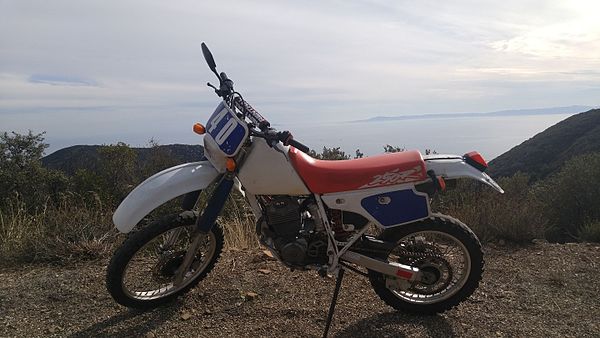
The XR250R was introduced pre 1981 and was originally equipped with a variation of the engine that had powered the XL250S since 1978. For 1983 the model was dropped from Honda’s line-up, but came back in 1984 with a completely new engine dubbed the “Radial Four Valve Chamber” (RFVC) engine. The original 250 cc (15 cu in) RFVC engine had a bore and stroke of 75 mm × 56.5 mm (2.95 in × 2.22 in), but in 1986 this was changed to 73 mm × 59.5 mm (2.87 in × 2.34 in). 1986 also saw the adoption of a large, single carburetor rather than the dual progressively opening carburetors of the 84-85 models. In 1996 the engine of the XR 250R, the mainstay of the XR range, was updated and now produced 19 hp (14 kW) at 8100 rpm. Changes included a new crankcase with better engine mounts (which incorporated the swingarm pivot) for a stiffer chassis, smaller exhaust valves to address a problem with cracking cylinder heads, and an improved automatic decompressor for easier starting. Although the XR250R was always quite heavy compared to its 2 stroke competition and both front and rear suspension were rather basic, it proved reliable and likable and was successful as an entry-level off-road machine. The XR250R was discontinued after 2004.
US XR 250L
This street version of the XR250R was built to conform to USA Department of Transportation regulations for street legal motorcycles, but was sold worldwide. It had road legal lights and tires, a steel fuel tank, keyed ignition/steering lock, lower seat height and other minor changes. Some 40 lb (18 kg) heavier, it had reduced off-road ability. It shared the XR250R’s RFVC 249 cc (15.2 cu in) engine, but with a different carburetor and 3 mm (0.12 in) smaller exhaust headers to meet emissions requirements. It was manufactured from 1991 to 2007.
There was a Brazilian equivalent named XR 250 Tornado made from 2001 to 2009 (until 2012 for export) for the local market and regional exports to other South American countries but also available in Mexico and Central America. Its engine was the same 4-valve DOHC air-cooled single fitted to the CBX 250 Twister/CBF 250, but the exhaust was dimensioned to improve low-end torque with the sacrifice of 1 hp resulting in a 23 hp rating.
XR250 (MD30) / XR250L
An electric start street version of the XR250R was sold in Asia as the XR250 and Australia as the XR250L. The Honda model designator for it is MD30. It’s based on the 1996-2004 model XR250R but with different suspension, fuel tank, rear subframe, electrical system, carburettor, cam shaft and most significantly the addition of electric start. There were two variants of the bike a single headlight version that looks more like the standard XR250R and a dual headlight “Baja” version.
XR 350R
The XR 350R was introduced for the 1983 model year and discontinued after the 1985 model year. The 1983 and 1984 models were wet sump engines with a bore and stroke of 84 mm × 61.3 mm (3.31 in × 2.41 in) and a displacement of 339 cc (20.7 cu in). The 1985 engine had a dry sump, a stroke of 63.8 mm and displacement of 353 cc (21.5 cu in). The wrist pin diameter was reduced from 21 mm to 19 mm and the dual progressive carburetors of the 83-84 models were replaced by a single large carburetor.
XR 400R
2000 XR400R with custom rack and aftermarket seat.
For other uses, see 400R (disambiguation).
The XR 400R was introduced in 1996. Its frame, plastics and suspension components were similar to those of the XR250R, and it had a similar air-cooled engine with RFVC cylinder head technology. The XR400R had more suspension travel and a longer wheelbase than the XR250R of the same year. Many XR400Rs were heavily modified and raced. The 400 was perhaps the most versatile of the XR line-up; many were raced in amateur motocross and enduro events. Equipped with street-legal lighting it also worked reasonably well as a dual purpose bike. It was simple, reliable and long lasting. Hard to break and easy to fix. In 2004 Honda discontinued the XR400R.
XR 400M
The XR 400M was introduced in 2005, and whilst having a similar engine to the XR 400R, the exhaust diameter is smaller and has a slightly lower power output. It was sold as a factory motard, with road wheels and tyres, electric start, and updated faux radiator fairings.
XR 500 / XR 500R
1980 Honda XR 500A
Introduced in 1979, the twin-shock Honda XR 500 was the first “XR” model. The engine was a four-stroke, four-valve OHC, 497 cc (30.3 cu in) “Pentroof” engine. The bike had a conventional 18″ rear wheel but an unusual 23″ front wheel which was supposed to be better for riding over potholes and ruts. The 23″ size proved unpopular and did not catch on as the wheel/tyre assembly was heavy, and there was little choice of replacement 23″ tyres.
In 1981 Honda introduced ‘Pro-Link’ models, with rising-rate single-shock rear suspension, a 17″ rear wheel and a 21″ front wheel. Unusual for a four-stroke with its typical intake and exhaust valves, the 1981 and 1982 XR-500 utilized a six-petal reed valve set-up between the carburetor and the intake valves. This was intended to provide better low-end performance while still allowing a large carburetor to be used. The 1982 XR 500RC was very similar to the 1981 RB apart from decal and trim changes.
The 1983 XR500R was thoroughly revised with a new dry-sump RFVC 5-speed engine which was lighter and more powerful than the older engine. Induction was by 2 carburetors, the first in use until 1/4 throttle, whereupon the second started to take effect. Power was 41 hp @6000 rpm, torque was 4.7 kg-m (34 lb-ft) at 5500 rpm, and dry weight was 266.7 lbs. The frame was entirely revised, and suspension was updated with 43mm air-adjustable forks with 11″ of suspension travel both front and rear. Wheels were 21″ front and 17″ rear. The fuel tank had a 12-litre capacity, the front brake was a single hydraulic disc, and the handlebars sported plastic ‘bark-buster’ hand protectors.
The 1984 XR500RE model was the last 500cc XR, being superseded in 1985 by the larger Honda XR 600RF.
XR 600R
Main article: XR 600R
A 1993 Honda XR600R
The XR 600R was used in Baja races. It was introduced in 1985, and was updated in 1988 when the original dual progressively opening carburetors were replaced with a larger single carburetor and the rear brake was updated to a disc. The 600 was updated again in 1992. The XR won many desert races in the hands of Johnny Campbell and GNCC races in the hands of Scott Summers.[citation needed] Its engine was very similar to the XR 400 and XR 250 engines, (though larger and heavier). 600’s responded well to modification. A common modification was to bore the cylinder to 100mm thereby increasing displacement to 628cc. HRC produced a “Power Up” kit that included a billet 100mm piston, a revised primary gear ratio (identical to that used later in the XR650L) and a hotter camshaft. XR600R’s so modified were used by the Honda race team in Baja, as well as by many other desert racers.
XR 650R
2003 Honda XR650R
Introduced in 2000, the XR 650R was not just an update to the XR 600—it was a totally new bike. An all-new 649 cc (39.6 cu in), liquid-cooled, SOHC engine was mated to an aluminum box frame. At 280 lb (130 kg) dry, it weighed more than the XR600R which it replaced, but was built very strong and the engine was immensely powerful. Honda was obviously aiming squarely at the long range desert racing market with this bike. Team Honda and the XR650R posted many definitive Baja 1000 wins during its production cycle, and many other desert race wins with Scott Summers and Johnny Campbell at the helm. Cancelled for the 2008 production year, the ‘Big Red Pig (BRP)’ enjoys a loyal following among Honda fans today, and remains one of the most competitive, open class 4-stroke enduro motorcycles available.
XR 650L
Main article: Honda XR650L
XR 650L
The Honda XR650L is a street/trail bike that is more similar to the XR 600R than to the XR 650R. It has a steel tube frame as opposed to an aluminum spar frame like in the XR 650R. It also has an air-cooled 644 cc (39.3 cu in) SOHC dry-sump single-cylinder four-stroke engine similar except for an increased displacement to the XR 600R, unlike the totally redesigned XR 650R that has a liquid-cooled 649 cc (39.6 cu in) SOHC dry-sump single-cylinder four-stroke engine.
The 644 cc (39.3 cu in) engine first appeared in the NX650 Dominator in 1988 which makes it the longest produced RFVC engine made by Honda. With a headlight, taillight, turn signals, mirrors, smog system, revised exhaust system and a 2.8 gallon gas tank with 0.6 gal reserve, the 650L has a 349 lb (158 kg) wet weight.
The Honda XR650L is one of the longest running unchanged production models in the history of motorcycling and is still available today exactly as the 1992 model specifications.[citation needed]
XRV650
Main article: Honda XRV650
The Honda XRV650 (produced from 1988 to 1989) was the second twin cylinder production trail bike by Honda, the first one being the Honda XLV750R produced from 1983 to 1986. It was the first twin cylinder model in the XR series and as such started the XRV series, but it was soon replaced by the Honda XRV750 in 1990. The 650cc model was built in Japan by Honda Racing Corporation and is arguably a better built bike than following versions of XRVs, which were standard production models. It came as both single and double headlight variations, and featured a slightly tuned 650cc engine similar to the Honda Transalp (XL600V and XL650V) and high specification chassis components, leading to its rather brief production run. With an aftermarket larger capacity tank and very few other modifications the bike was entered in the marathon class of the Paris Dakar Rally, revealing its surprisingly good off-road abilities – despite its 200 kg weight, hence it belongs firmly to the XR range. It is the most sought after model of the Africa Twin XRV range and is fast becoming a collector’s item, especially in Europe.
742 cc (45.3 cu in) 52° V-twin. SOHC, 3 Valve per cylinder
Bore / stroke
81.0 mm × 72.0 mm (3.19 in × 2.83 in)
Compression ratio
9.0:1
Power
45.3 kW (60.7 hp)@ 7,500 rpm
Torque
62.7 N⋅m (46.2 lbf⋅ft)@ 6,000 rpm
Ignition type
CDI with electronic advance
Transmission
5-speed manual, chain final drive
Frame type
Single downtube with double-loop cradle, rectangular section, steel
Suspension
Front: 43 mm air-assisted telescopic fork, 220mm wheel travel Rear: Pro-Link 214mm wheel travel with preload and compression damping adjustment
Brakes
Front: two 276 mm discs 2 piston calipers Rear: Single 256 mm disc 1 piston caliper
Tires
Front: 90/90 D21 Rear: 140/80 R17
Dimensions
L: 2,315 mm (91.1 in) to 2,380 mm (94 in) W: 905 mm (35.6 in) H: 1,243 mm (48.9 in)
Seat height
860 mm (34 in)
Fuel capacity
23 L (5.1 imp gal; 6.1 US gal)
The XRV750 Africa Twin was a 742 cc (45.3 cu in) dual-sport first launched in December 1989. and based on the Honda NXR-750, which won the Paris-Dakar rally four times in the late 1980s (from 1986 to 1989).
Description and technical
XRV750 Africa Twin 1993
It was preceded by Honda XRV650 Africa Twin, which was a lighter, higher specification version made in 1988 and 1989 by Honda Racing Corporation with a 650 cc engine producing 50 hp (37 kW). The much earlier Honda XLV750R was a shaft driven motorcycle.
Built in homage to the giant desert racers of the Paris-Dakar Rally, the Africa Twin is a large, dual sport bike, powered by a softly tuned V-twin engine. It has twin headlights, a windscreen, and a long dual seat which stretches back from the tank to an aluminium grabrail and plastic coated luggage rack. An aluminium bashplate protects the bottom of the engine from flying rocks and impacts.
XRV 750 Africa Twin Adventure Sports
The engine is a 742 cc, liquid-cooled V-twin with a single overhead camshaft, 6-valves (3 per cylinder) and four spark plugs (2 per cylinder). The long-travel suspension insulates the rider from uneven surfaces. The brakes are twin discs at the front and single disc at the rear.
History and update
Trip Computer of XRV
In December 1989 the original Honda XRV750 Africa Twin was launched, which became known as the 1990 model. In 1990 was updated. In 1992 the Tripmaster computer was added. In 1993 the motorcycle had a major redesign including new frame, body work plastics, fuel tank, engine modifications and a lower seat. Nevertheless, it gained weight slightly. In 1996 the XRV gained an improved seat and clutch, larger silencer, modified upper fairing and luggage rack. However, the rear shock absorber lost some of its adjustability. In 2000 the Honda XRV750 Africa Twin ceased production. XRVs still in the showrooms were sold and registered until 2003 but there is no XRV with a VIN that is newer than 2000. Nowadays good second hand examples are very much sought after among aficionados. Several aftermarket products exist with which to equip the bike such as crash bars to protect the vehicle’s plastics and tank from damage in a low speed fall.
The later XRV’s instruments feature a large trip computer LCD display mounted above the conventional speedometer and tachometer, styled like Dakar racers’ navigational displays, and incorporates a range of extra electronic timers and trip meters.
Specifications
XRV750 Africa Twin
L to N models (1990 to 1992)
P to S models (1993 to 1995)
T models onwards (1996 on)
Overall length
2315 to 2380 mm
Overall width
895 mm
905 mm
Overall height
1,420 mm
1430 mm
Wheelbase
1,565 mm
Seat height
880 mm
860 mm
870 mm
Weight (dry)
209 kg
205 kg
Fuel tank capacity (including reserve)
24 litres
23 litres
Wheels
Front 21-inch spoke, aluminium rim 1.85×21″ Rear 17-inch spoke, aluminium rim 2.75×17″ and 3.00×17″
Tyres
Front 90/90-21 54S Rear 130/90-17 65S
Front 90/90-21 54S Rear 140/80-R17 69H
Later versions
Africa Twins were originally built with a V-twin layout, but current models use a parallel twin engine with a 270° crankshaft (as pioneered by the Yamaha TRX850). The new engine was cheaper to build, lighter and more compact, allowing both a shorter wheelbase and easier placement of inlet and exhaust manifolds. Also, the 270° engine’s “big bang” concept allows excellent rear wheel grip to the track surface.
References
External links
Partial history update of XRV750 on honda.co.jp
Test 1992: Cagiva Elefant vs Honda Africa Twin vs BMW R 100 GS vs Yamaha XTZ 750
647 cc (39.5 cu in) 52° V-twin. SOHC, 3 Valve per cylinder
Bore / stroke
79 mm × 66 mm (3.1 in × 2.6 in)
Compression ratio
9.4:1
Power
57 hp (43 kW)@ 8,000 rpm
Torque
55 N⋅m (41 lbf⋅ft)@ 6,000 rpm
Ignition type
CDI with electronic advance
Transmission
5-speed manual, chain final drive
Frame type
Single downtube with double-loop cradle, rectangular section, steel
Brakes
Front: single 296 mm disc 2 piston calipers Rear: Single 240 mm disc 1 piston caliper
Dimensions
L: 2,295 mm (90.4 in)
The XRV650 Africa Twin is an enduro motorcycle produced by the Japanese manufacturer Honda from 1988 to 1989. The enduro is derived from the design of the Honda XL600V Transalp and is powered by the V-twin cylinder engine of the Honda NT650 Hawk.
History
In response to the motorsport successes of the BMW R80 GS in the early 1980s, the Honda Racing Corporation (HRC) was commissioned in 1984 to develop a desert-capable, off-road motorcycle for the Paris-Dakar Rally. In 1985 the NXR750V was presented with a water-cooled twin-cylinder with a displacement of 779 cm3 and a rated output of 48 kW (65 hp). This motorcycle won the Paris-Dakar Rally four times in a row from 1986 to 1989.
The Africa Twin XRV 650 with manufacturer code RD 03 is not based on the works rally motorcycle NXR 750, but has adopted its look after the success of the NXR in the 1987 Paris-Dakar Rally. Despite a weight of 220 kg with a full tank, the travel enduro was easy to maneuver both on and off-road. In Germany, because of the cheaper type class, the power was reduced by throttling from 57 hp to 50 hp. The top speed is 165 km/h at a speed of 7,640 rpm . The aluminum rims have steel spokes and are fitted with cross-ply tires at the front and rear. The RD 03 decelerates at the front via a disc brake with a two-piston caliper and at the rear with a disc brake with a single-piston caliper. The motorcycle was only available in the Honda Racing Corporation (HRC) color combination (white-red-blue) until 1991.
Construction
The water-cooled four-stroke engine is mounted transversely in the frame so that the two cylinders of the V-engine are positioned one behind the other at an angle of 52° to the crankshaft. The two cylinders have a bore of 79 mm, the pistons have a stroke of 66 mm and a compression ratio of 9.4:1. Each cylinder head has a chain-driven camshaft that controls one exhaust and two intake valves. The engine and transmission block unit is vertically separated and made of aluminum alloymanufactured. The crankshaft transmits its torque via gears to a multi-plate wet clutch on the input shaft of the gearbox. The gearbox has five gears and is connected to the rear wheel via a chain.
Undercarriage
The chassis consists of a single-loop tubular steel frame with a double upper section made of rectangular profiles and a classic rear frame. The two stanchions of the telescopic fork have a diameter of Ø 43 mm and a spring travel of 230 mm. They are connected to each other via a fork bridge above the front wheel. The aluminum shock absorber on the rear wheel swing arm has a deflection system and is infinitely adjustable in terms of both spring preload and damping.
Cooling
The engine is cooled with a mixture of water and antifreeze, which dissipates the combustion heat from the two cylinders to the ambient air via two radiators. A coolant pump driven by the oil pump conveys the hot coolant to the coolers and back via a thermostat valve, with the thermostat only fully opening from an operating temperature of 95 °C. The right-hand radiator has a cooling fan as additional cooling for coolant temperatures above 100 °C.
Rally use
The motorcycle was successfully used as the RD 03 Marathon in 1989 and 1990 by Honda France in the marathon class of the Paris-Dakar Rally. A rear tank and an enlarged main tank were installed for the long stages. Many other changes were made to this model such as an engine guard with a water compartment, a modified swingarm for attaching a chain guide and crash bars for the radiators. However, the standard air filter box proved to be problematic. In the second year of the RD 03 Marathon, this was converted to an air intake behind the tank cap.
Honda Bravo Honda Nice / RS 125 / RS 125 Fi Honda Sonic
The Honda XRM is an underbone-style motorbike produced and sold in the Philippines since 2001 by Honda Motors Philippines. The Honda XRM was originally released with a 110 cc (6.7 cu in) engine, but was later changed to a 125 cc (7.6 cu in) engine taken from the Honda Wave. It is designed for both on- and off-road use.
The XRM also spawned a non-off-road variant (later a separate model) called XRM 125 RS (where RS means Road Sport) which was later re-launched into a separate model as RS 125 Fi. It still share most of major components with the XRM such as the chassis and the engine, with major differences in body style and overall appearance to resemble more closely with the unrelated Honda RS 150R. This variant was also sold in Thailand as the Honda Nice.
Since 2021, it was sold in New Zealand as a non-street legal farm bike.
Its flexibility on modifications, and readily available parts and accessories have made the Honda XRM popular, particularly with the underbone riding culture, with numerous rider clubs being formed across the country. These modifications (especially to the handlebars and wheels) can pose danger, as they are not included in the product’s engineering, and often defeat the “dual-sport” nature of the motorbike.
The Honda Bravo is a derivative of the Honda XRM designed for city use, but it carries the same frame that is used by NF100 (Wave100 – both models) not the frame of the XRM.
Front: telescopic fork, 245 mm travel Rear: Pro-link 225 mm travel
Brakes
Front: single 256 mm disc, two-piston caliper (base) or three-piston caliper (C-ABS) Rear: single 220 m disc, single-piston caliper Optional Combined ABS
L: 2,171 mm (85.5 in) W: 830 mm (33 in) H: 1,181 mm (46.5 in)
Seat height
860 mm (34 in)
Fuel capacity
13.6 L (3.6 US gal)
Oil capacity
2 L (0.53 US gal)
The Honda XRE 300 is a single-cylinder dual-sport motorcycle designed and manufactured by Honda in Brazil. It was launched in August 2009 to simultaneously replace the Japanese firm’s two South American on/off-road motorcycles: the XR250 Tornado and the NX-4 Falcon. Unlike these motorcycles’ 250 cc and 400 cc engines, the fuel-injected (Programmed fuel injection) 300 cc engine in the XRE300 meets Brazil’s new PROMOT 3 emissions rules.[better source needed] It has an anti-lock brake (ABS) option.
Heavily based on its 250cc predecessor, the XRE300 is aimed at urban riders but can be used for light trail work. The XRE300 is used by motorized infantry brigades of the Brazilian army. In 2018 the Policia Nacional in Colombia acquire this model for their police officers, Cali, Bogota, Medellin started with it and moreover all country.
The bike has become an excellent choice for those adventurers who want to travel on- or off-road routes moreover trusting in the recognition, reliability and goodwill done Honda Motor Company by across the years in LATAM.[citation needed]
Developed as a dual-sport motorcycle, the XRE 300 delivers an engine power close to 26 hp @ 7500 rpm offering a cruise speed average between 85 km/h and 90 km/h in the middle range of the tachometer (5000 rpm – 5500 rpm) with no compromise neither the bike durability, fuel consumption or rider comfort.
The display shows the top speed of 134 km/h just at the red line of the tachometer (9000 rpm).
The bike has a superior Trail off-road capability with an engine torque close to 27 Nm @ 6500 rpm giving excellent performance in the low and middle range of the revs (1500 rpm – 6500 rpm) such response is a goal with either sand, mud or gravel ride conditions.[citation needed]
Metzeler Enduro 3 Sahara tires are standard. These are 50% on-road / 50% off-road tires with self-cleaning treads, designed for good overall traction and braking on dry and wet roads.
Models and Technical improvements
There are different versions of the same model:
Brazil, Argentina first series 2009–2014.
Brazil, Colombia 2015–2016. Since 2015 the motorcycle include new improvements such as:
New digital LCD Display, including km/L measurement.
Improved spark plug air cooing duct.
Reoriented throttle cables at the handlebar side.
Combined braking system C-ABS (only for XRE300 ABS models).
New fairings design, colors and rally version fairings availability.
New articulated fuel cap.
Brazil, Worldwide, 2019 – current
New front fender design.
New fairings design.
New head, tail lamp and turn signal lights design.
New black carrier design.
Fuel technology
All the XRE Models can use either gasoline or ethanol, which Honda’s PGM-FI system can detect and adapt to.
Manual of model distributed in Guatemala states that a max. of 10% Ethanol is allowed within fuel.
References
External links
Molina, Daniel. “PubliMotos – Prueba Honda XRE 300”. www.publimotos.com (in European Spanish).
Air-cooled 644 cc (39.3 cu in) SOHC dry-sump single-cylinder 4-stroke
Bore / stroke
100.0mm x 82.0mm
Compression ratio
8.3:1
Ignition type
Electric starter
Transmission
Five-speed
Suspension
Front: 43mm air-adjustable leading-axle Showa cartridge fork with 16-position compression-damping adjustability; 11.6-inches of travel
Rear: Pro-link Showa single-shock with spring-preload, 20-position compression- and 20-position rebound-damping adjustability; 11.0-inches travel
Brakes
Front: Single disc with twin-piston caliper Rear: Single disc
Tires
Front: 3.00-21 Rear: 4.60-18
Rake, trail
Rake- 27.0 degrees
Trail- 102.0mm (4.0 inches)
Wheelbase
57.3 inches (145.5 cm)
Seat height
37 in (940 mm)
Weight
349 lb (158 kg) (wet)
Fuel capacity
2.8 US gal (11 L; 2.3 imp gal)
Oil capacity
1.9 L
Fuel consumption
47.7 mpg‑US (4.93 L/100 km; 57.3 mpg‑imp)
The XR650L is a dual-sport motorcycle manufactured by Honda, part of the Honda XR series. It was released in 1992 as a 1993 model. It combines the RFVC engine from the proven NX650 Dominator dual sport with the lighter, off-road capable XR600R chassis, the latter of which is not road legal in the US. It has been produced virtually unchanged since 1993 and is still in production as of 2024.
The engine is a 40 hp, air-cooled 644 cc (39.3 cu in) SOHC, dry-sump, single-cylinder, four-stroke. With an electric starter, headlight, taillight, turn signals, mirrors, US EPA and California Air Resources Board (CARB) compliant exhaust system, and a 2.8-US-gallon (11-litre; 2.3-imperial-gallon) metallic fuel tank, the 650L has a 349 lb (158 kg) wet weight. The seat height is 37 inches (940 mm).
The Honda XR600R was an offroad dual-sportmotorcycle powered by an air-cooled single cylinder, four-stroke engine, manufactured by Honda from 1985 to 2000, and is part of the Honda XR series. The currently available road oriented XR650L model is similar to the XR600R with an engine of more displacement but lower compression and less horsepower.
The engine displacement is 591 cc with four valves placed in a RFVC (Radial Four Valve Combustion) radial disposition with a single camshaft. It has a dry sump lubrication system. The engine has a compression of 9.0:1 with a bore/stroke of 97 × 80 mm. The engine is fed by a 39 mm piston-valve carburetor.
The front suspension is managed by two conventional cartridge valve 43 mm forks with compression and rebound adjustability, and in the rear is a Prolink single shock with preload, compression and rebound adjustability. The bike has a five-speed transmission and a kickstarter.
General specifications for the Honda XR600R
Specifications for 1992 model and on, unless noted
Engine Type
Single cylinder, air-cooled, four-stroke, SOHC, 4 valves
Carburetion
Keihin PD8-AF, Ø39 mm (85-87 featured dual 28mm carbs)
Displacement
591 cc
Bore × Stroke
97.0 mm × 80.0 mm (3.82 in × 3.15 in)
Fuel Capacity
2.6 US gallons, plus 0.8 gal reserve
Oil Capacity
2.3 L (2.4 US quarts)
Wheelbase
1455 mm (57.3 in)
Overall length
2160 mm (85.0 in)
Overall width
900 mm (35.5 in.)
Overall height
1215 mm (47.8 in)
Seat Height
955 mm (31 to 37
1⁄2 in) depending on year and model
Ground clearance
345 mm (13.6 in)
Tires
Front: 21 in 80/100; Rear: 18 in 110/100 (’85-’87 had 17″ rear wheels)
(84-85) 37mm damper rod forks with 10 in (250 mm) of travel
(86-89) 41mm damper rod forks with 11 in (280 mm) of travel. Has base valve compression clicker. Cartridge emulator ready.
(90–95) 41mm cartridge forks with 11 in (280 mm) of travel. Has no clickers. Not cartridge emulator ready.
(96-04) 41mm cartridge forks with 10.6 in (270 mm) of travel with base valve compression clicker
Rear:
(84-85) Monoshock with 9.6 in (240 mm) of travel
(86-95) KYB 40mm Mono Shock with 11 in (280 mm) of travel
(96–04) KYB 44mm Mono Shock with 10.6 in (270 mm) of travel. Uses knobless clickers. Piggyback reservoir.
Brakes
Front:
240mm disc
Rear:
(79–89) drum
(90–04) 220mm disc
Tires
Front: 80/100-21
Rear: 100/100-18
Rake, trail
(85–95) 25°, 100 mm (3.9 in)
(96–04) 24°, 92 mm (3.6 in)
Wheelbase
(86–91) 1,420 mm (56.1 in)
(91–95) 1,410 mm (55.7 in)
(96–04) 55.1 in (1,400 mm)
Dimensions
L:
(86–91) 2,100 mm (82.7 in)
(91–95) 2,110 mm (83.1 in)
W:
(86–91) 910 mm (35.8 in)
(91–95) 900 mm (35.4 in)
H:
(86–91) 1,230 mm (48.3 in)
(91–95) 1,200 mm (48 in)
Seat height
(86–95) 920 mm (36.4 in)
(96–04) 910 mm (36 in)
Weight
(86–91) 108.6 kg (239.4 lb) (claimed)
(91–95) 108.0 kg (238.1 lb) (claimed)
(96–04) 110 kg (240 lb) (claimed)
(dry) 260lbs (wet)
Fuel capacity
(86–95) 9.0 L; 1.98 imp gal (2.38 US gal) 2.6 US gal (9.8 L; 2.2 imp gal)
Oil capacity
(86–95) 1,600 ml (1.7 US qt)
The Honda XR250R and XR250L are trail and dual-sport motorcycles made by Honda from 1979 through 2004, as part of the Honda XR series. They have four-stroke, SOHC four-valve 249 cc (15.2 cu in) single-cylinder engines.
In 1981, the XR250 was updated with a single rear shock. In 1984, the bike was introduced with Honda’s Radial Four Valve Combustion Chamber (RFVC).[citation needed] It has a 110 kg (240 lb) claimed dry weight, and a 36-inch seat height (96–04). Honda claims the engine produces 28 horsepower at 8000 rpm and 17 ft-lb feet of torque. The 1996–2004 versions of the XR250R had 10.6 inches of suspension travel front and rear and 41mm front cartridge forks. The tire size was 80/100-21 front and 100/100-18 rear. It had 13–48 tooth gearing and a stock top speed of around 76 mph at 8000 rpm. The XR250L was a heavier, street-legal version which was introduced in 1991 and should not be confused with the older XL250R. Starting in 1981, the XR250 had a 21-inch front wheel. 1979 and 1980 versions had a 23-inch front wheel (3.00 x 23 tire size).
Unlike the CRF230F, which effectively replaced the XR200R in Honda’s lineup as an air-cooled off-road motorcycle, the XR250R has no air cooled successor until the CRF250F in 2019. That said, the ‘F’ shares little more with the XR than it being a great starter play bike, 4 valve head, and an air cooled low maintenance bike. They are a different thing altogether with the ‘F’ meaning fuel injected, with the suspension limited to 9.8” of travel, seat height lower by 2”, electric start, and a 5-speed transmission. The ‘F’ in stock form is a far more modern engine. The ‘R’ power plant feels dated and is lower performing in comparison, despite higher output power.
The engines in both the XR250R and XR250L are identical. In the United States the L has a 3 mm smaller header pipe and a different carburetor to satisfy emissions regulations, though both carburetors have a 30 mm bore. The engine has a four-valve head with splayed rocker arms to actuate the valves. Unusual for a single-cylinder engine, it has a two-into-one header pipe. Throughout its production, the R version is kickstart only, has a six-speed transmission with chain final drive, and has stator ignition. For the pre-1996 models, the suspension travel was 280 mm (11 in) front and rear. The XR250R is the enduro (competition) model; however, the L version is electric start, (except for the USA market XR250L, which never had electric start and which was discontinued after the 1996 model year), with pillion pegs, softer suspension and lower seat height. The changes between 1996 and 2004 consisted of decal updates, the mechanical parts being identical. The XR250R was discontinued after 2004. In Australia a XR250Y was released with upside-down forks and electric start in 05–06.
The 1991 Honda XR250L is the most sold of the entire XR series with more than 814,000 units being sold.
Single carburetor. Engine saw a smaller bore & longer stroke. 73mm bore × 59.5mm stroke.[citation needed]
Oil Cooler added to ‘R’ only.
1990
Rear disc brake and clickerless cartridge forks
1996
Revised suspension with 10.6 in (270 mm) of travel and a steeper steering angle. Front forks with more ground clearance and compression clickers.
Rear Shock increased to 44mm with piggyback reservoir from 40mm hosed.
Updated dry-sump engine with lighter flywheel and counterweights. New engine mounts, exhaust valves, decompression at CAM, and swingarm pivot through engine case.
Removable rear subframe with hinged airbox door.
Lighter and less plush seat. Longer Aluminum kickstart lever. Revised larger footpegs. Reduced frame guard to match oil in frame.
Increased steering stem height compatible with the XR400.
References
External links
“Two For the Trail”, Cycle World, pp. 50–54, January 1986
Bore and Stroke: 79.5mm x 75.5mm Compression Ratio: 8.4:1 Valve Train: SOHC; three valves with hydraulic tappets per cylinder
Carburetion: two 36mm Keihin suction carburetors
Power
45.5 kW (61.0 hp) at 7000 rpm
Torque
69 N⋅m (51 lb⋅ft) at 5500 rpm
Ignition type
CDI, two spark plugs per cylinder
Transmission
5-speed manual, Shaft final drive
Brakes
Front: disc Rear: drum
Wheelbase
1480 mm
Seat height
860 mm
Weight
189 kg (416 lbs) (dry) 220 kg (484 lbs) (wet)
Fuel capacity
19.4 liters (including the 5 liter reserve)
The Honda XLV750R is a dual-sport motorcycle manufactured from 1983 to 1986 by Honda Motor Company, Japan. A first prototype of the motorcycle was introduced to the public at the Paris Motor Show in October 1982. The XLV was initially intended for the European market only (with the exception of the UK), but from 1985 on, it was also sold in Australia and New Zealand. In the first production run in 1983, 500 “Limited Edition”-models were produced for the Japanese home market. The “Limited Edition”-models can be identified by a golden metal badge attached to the right side of the auxiliary frame (below the seat) and are otherwise, except for the perforated front brake disc and the blue strap on the seat, identical to the standard model.
Description and history
Honda had intended the XLV to be a tourer with limited off-road capabilities. It is therefore hard to understand why Honda presented the motorbike to the press on a motocross track (on the island of Ibiza, Spain, in the spring of 1983). In the early 1980s, most dual-sport motorcycles had only one cylinder and weighed about 120 to 150 kilos – compared to them, the XLV with its 220 kilos (fully fueled) seemed to be unfit for sporty off-road driving. At the launch, several journalists crashed the heavy bike on the motocross track, for which it was entirely unsuited.
The XLV750R (Honda type designation: RD01) was Honda’s first dual-sport motorcycle with two non-parallel cylinders. It has an air-/oil-cooled V-twin engine with hydraulic valve tappets and a shaft drive. Those two construction features make the XLV a very low maintenance motorcycle. Other technical highlights at the time of introduction were the dry sump lubrication system (with the main frame acting as an oil tank, helping to lower engine temperatures), the three valves per cylinder (two inlet valves / one exhaust valve), the two spark plugs per cylinder, and the crankshaft with off-set pins.
Honda XLV750R(D)
The distinctive air scoops mounted below the fuel tank on either side of the motorbike provide additional cooling for the rear cylinder. They were only installed after tests of prototype models revealed thermal problems of the engine.
Initially the XLV was offered in the aggressive colours of the Honda Racing Corporation (HRC), namely blue, white, and red, with a red engine, red fork rods and red hubs. This model bears the additional designation “D”.
Honda XLV750R(F)
In 1985, a revised version of the XLV750R was introduced, bearing the additional designation “F”. The XLV750R(F)-models were improved in some details (tamer cams resulting in 6 hp less power, improved automatic cam chain tensioners, improved carburetor setup, among other minor modifications) and had a black engine and golden rims with black hubs. These motorcycles were painted in the colour combinations black/blue metallic, black/red metallic and black/silver grey and were mainly marketed in Italy, France, and Australia. Honda never officially offered them in Germany, probably because the demand was very low due to the mainly negative press the XLV had received there.
In 1986, the production of the XLV750R (RD01) was discontinued. Officially, the RD-genealogy was continued with the solely chain driven models NX650 Dominator (RD02 and RD 08), XRV650/750 Africa Twin (RD03, RD04, RD07), XR650L (RD06), SLR650/FX650 Vigor (RD09), XL650V/XL700V Transalp (RD10, RD11, RD13) and FMX650 (RD12). The type designation “RD05” was not assigned.
Due to its (in Honda proportions) low production numbers of approximately no more than 10,000 units worldwide (“D”- and “F”-models combined), the XLV750R is quite seldom seen – and in many countries, especially outside of Europe and Australia, it is an extremely rare bird.