The Big RuckusPS250 is a 250cc, CVT transmission-equipped two-seater scooter, manufactured by Honda; marketed in Japan for model years 2004-2007 and in North America for model years 2005-2006 — and noted for its minimal bodywork and expressed light-weight steel tubular frame, akin to the Honda Zoomer.
Styling
Noted for its minimalist styling, the scooter features an expressed painted tubular steel frame (e.g., yellow or silver) with contrasting (black) plastic infill panels and two prominent 7″ headlights. While Motorcyclist said it had “rugged style,” and Motorcycle.com said it had “a hairy chest,” Canadian Motorcycle Guide said the bike had “bizarre, naked styling, and big-googly eyes and the Los Angeles Times said “to some people it might look like a rabbit carcass after a hawk has had its way.”
Honda described the target market for the Big Ruckus as ranging “from urban deliveries (that’s Pizza), to the back of motor-homes, to the entry/commuter/female rider or just as a cottage runabout.”
Design
The water-cooled 249 cc engine features an aluminum cylinder head with a compression ratio of 10.5:1; fan-cooled radiator; 30 mm carburetor; auto enriching system (i.e., no choke); electric start; fully transistorized ignition and air injection emissions system.
The Big Ruckus features seating for two; fold up pillion to provide a solo-rider backrest (fully down or fully up at 75 degrees); fore and aft sliding seat; cast aluminum wheels; hand-lever cable operated parking brake; side-mounted storage canister; tubular side grab handles/tie-down hooks; tubular front cargo area; center as well as side stand; twin front headlights; folding passenger footrest and forward mounted foot rests “similar to those on most cruiser style motorcycles;” and linked brake system, where the rear lever also actuates the front brakes (with the right-hand lever only operating the front brake while the left does both front and rear). The expressed tubular frame design offers no wind protection.
Marketed in North America at a MSRP of $5500, the bike’s instrumentation includes trip odometer, analog speedometer, indicator lights for oil temperature and parking brake and fuel gauge, as well as visible as well as audible turn signals.
Reception
A 2005 review in Cycle World magazine said “what the Big Ruckus lacks in torque it makes up in fun,” adding “the seat is all-day comfy and the flip up backrest is a hoot.” The review noted the scooter had poor brakes and a rough ride.
In a 2006 review, Motorcycle.com described the Big Ruckus, saying “the riding position and overall feeling that the bike conveys is more closely related to a big cruising motorcycle than a conventional scooter.”
References
External links
Honda Japan official PS250 website
Canadian Motorcycle Guide Online Archived 2009-08-09 at the Wayback Machine 2005 model review
L: 1,765 mm (69.5 in) W: 712 mm (28.0 in) H: 1,115 mm (43.9 in)
Fuel capacity
7 L (1.8 US gal)
The Honda Bali is a 100 cc (6.1 cu in) two-stroke twist and go scooter from Honda. The scooter has self-starter and autolub system to mix two-stroke oil with fuel. The top speed with 85 kg load is around 80 km/h.[citation needed] Front brake is disc while rear is drum.
The scooter weighs around 93 kg,[citation needed] Fuel capacity is 7 liters and oil capacity (two-stroke oil) is 1.2 liters. Its automatic dry centrifugal clutch is driven by V-belt. Engine compression ratio is 6:1.
This Scooter is produced by Honda Italia Industriale in Atessa, Italy since March 1993.
109 cc (6.7 cu in), four-stroke, air-cooled, OHC, single-cylinder
Power
8 bhp
Torque
8.77 Nm
Ignition type
Electric start
Transmission
V-Matic
Suspension
Front: telescopic Rear: swingarm with spring-loaded hydraulic damper
Brakes
130 mm drum or 190 mm disc (only available for front wheel)
Wheelbase
1,256 mm (49.4 in)
Dimensions
L: 1,802 mm (70.9 in) W: 703 mm (27.7 in) H: 1,162 mm (45.7 in)
Seat height
790 mm (31 in)
Weight
103 kg (227 lb) (dry)
Fuel capacity
4 L (0.88 imp gal; 1.1 US gal)
Oil capacity
0.8 L (0.18 imp gal; 0.21 US gal)
Fuel consumption
60 km/L
Related
Honda Activa
The Honda Aviator was a motor scooter produced by Honda Motorcycle and Scooter India. Its slogan is “Live Your Style”. It has a four-stroke 109 cc (6.7 cu in) single-cylinder engine, HET air-cooled engine (the same as in the Dio and the Activa) which produces 8 bhp at 7000 rpm and maximum torque of 8.77 Nm at 5500 rpm. The scooter has V-Matic transmission and can be kick-started or self-started. With the recently updated Honda Eco Technology (HET) the scooter has company-claimed efficiency of 60 km/L.
In 2018, the scooter received a minor update from Honda which included a new instrument console and LED headlamp.
It was discontinued in April 2020 after the BS6 emission norms took effect.
For automobiles marketed under that name, see Honda Ascot.
Honda FT500 motorcycles
The Honda Ascot is a name given to two motorcycles produced by Honda in the early 1980s. The motorcycles, the FT500 and VT500FT, were produced with the Ascot name between 1982 and 1984 as part of the Honda VT500- engine series.
FT500 (1982)
The Honda Ascot, designated FT500, was sold in 1982 in the colors Monza Red or Black. The tank stripes and the “FT500” decal are gray and silver on the red bike and red and orange on the black bike. On American bikes, the speedometer was limited to 85 mph (135 km/h) as was required, in other markets the bike received a 180 km/h (112 mph) speedometer. The headlight is rectangular and so are the instruments. The engine is a 498 cc SOHC, 4-valve single-cylinder with 8.6:1 compression ratio, and one carburetor, producing 35 PS (26 kW) at 6500 rpm. This balance shaft-equipped engine was derived from that of the Honda XL500 [de] enduro motorcycle, but tuned for highway usage through the use of a vacuum carburetor and other adjustments. The transmission is a 5-speed (1st=2.462:1 2nd=1.647:1 3rd=1.250:1 4th=1.000:1 5th=0.840:1), also from the XL 500 but with tempered gears and a stronger chain. Stock gearing is 15/42 (3.71:1). The brakes are twin piston disc front and rear and the bike has an electric starter, foregoing a kickstart entirely. The 156 kg (344 lb) motorcycle has a top speed of about 150 km/h (93 mph) and achieved an average fuel economy of 48 mpg. The serial numbers begin with JH2PC0708CM000019.
FT500 (1983)
The 1983 FT500 was also sold in Monza Red or Black. The tank and side cover stripes on the red bike are white and blue; and on the black bike, they are silver and red. The headlight and instruments are rectangular. The speedometer has a 120 mph (195 km/h) limit. The engine remained the 498 cc OHC, 4-valve single cylinder with one carburetor. The transmission is a 5-speed. The serial numbers begin with JH2PC070*DM100001. The brakes are dual piston, front and rear.
VT500FT (1983)
The 1983 VT500FT Ascot received a twin cylinder rather than the single-cylinder used on earlier models. It was sold in one of two colors: Pearl Siren Blue or Candy Bourgogne Red. The side cover panel on the blue bike is silver; and on the red bike, the panel is black. The gas tank wing decal is two-tone. The 2-into-1 exhaust system is black chrome. The engine is a 491 cc OHC, 3-valve, liquid-cooled V-twin linked to a 6-speed transmission (1st: 2.86, 2nd: 1.95, 3rd: 1.55, 4th: 1.28, 5th: 1.07, 6th: 0.87) and a shaft drive. The serial numbers begin with JH2PC070*DM100001.
VT500FT’84
The VT500FT’84 Ascot was sold in 1984 in one of two colors: Black or Red. The side cover panel on the black bike is silver; and on the red bike, the panel is black. The gas tank wing decal is three-tone. The 2-into-1 exhaust system is black chrome. The engine is a 491 cc OHC, 3-valve, liquid-cooled V-twin linked to a 6-speed transmission and a shaft drive. The serial numbers begin with JH2PC070*EM100001.
Honda Motorcycle and Scooter India Honda de México
Also called
Honda Activa e: (Electric Scooter)
Production
2001; 24 years ago (2001)–present;
Predecessor
Kinetic Honda
Successor
Activa 125
Engine
125 cc (7.6 cu in) or 109 cc (6.7 cu in), air-cooled(100), OHC, four stroke, single
Power
7 or 8 bhp (5.2 or 6.0 kW) in 2009 model (claimed)
Torque
8.74 Nm (claimed)
Transmission
CVT
Suspension
Bottom link with spring-loaded hydraulic damper (front), unit swing with spring-loaded hydraulic damper (rear)
Brakes
Drum, 130mm (front & rear) with CBS (only in 2009 model)
Tires
297 90/100-10 53J
Wheelbase
1,238 mm (48.7 in)
Dimensions
L: 1,761 mm (69.3 in) W: 710 mm (28 in) H: 1,147 mm (45.2 in)
Seat height
765 mm (30.1 in)
Fuel capacity
5.75 L (1.26 imp gal; 1.52 US gal) or 5.3 L (1.2 imp gal; 1.4 US gal) in 2009 model
Exhaust Sound of Honda Activa
The Honda Activa is a motor scooter made by Honda Motorcycle and Scooter India (HMSI). It was launched in India in May 1999. Production in Mexico began in 2004. It is a 109/125 cc, 7 bhp (5.2 kW) scooter. The vehicle has the option of kick- and self-start.
History
Honda began selling a new version of the Activa in the Indian market on 8 May 2009, with a new 109 cc (6.7 cu in) engine. Honda said the Fuel economy was improved by 15%.
In April 2014, Honda began an upgraded model of Activa with a 125 cc (7.6 cu in) engine and rebranded the model as Activa 125. Currently, both Activa-i and Activa 125 are sold in India along with traditional Honda Activa.
Honda began selling the Activa-i in India, a cheaper and lighter version of the Activa, in December 2013. It is powered by a 110 cc (6.7 cu in) engine. On September 22, 2015, Honda announced that they had sold over 1 million Activas in five months in the Indian market, from April to August.
Honda launched their 5th generation of Honda Activa in 2018, and the sixth-generation Honda Activa 6G have been launched in India with prices starting at ₹ 63,912 (ex-showroom, Delhi).
Milestones
In April, 2014, The Economic Times reported the Honda Activa to be the best selling two wheeler in India, outselling the Hero Splendor. During the month of September 2013, 141,996 Honda Activa scooters were sold, nearly equal to Honda’s entire annual sales in North America.
The 110cc Activa is the company’s biggest seller, by far. It is responsible for over 200,000 sales units each month.
In November 2018, HMSI crossed the 2.5 crore sales mark in the scooter segment. It has become the first company to reach this milestone and the biggest contributor to this massive figure is the Honda Activa.
It took Honda 13 years to achieve the one crore sales figure, but it managed to add another crore in the span of just three years. It then went on to achieve the next 50 lakh in just one year. Honda claims that it is now India’s top scooter-selling brand, holding 57 percent of the market share. Honda has also said that every second scooter sold in India is one of theirs.
Awards
Source
2001
Scooter of the Year 2001 (BS Motoring)
2002
Scooter of the Year by Overdrive Magazine
2007
Best automobile brand of India 2007 (Planman Media)
2008
Scooter Customers Satisfaction No.1 – CNBC TV18 – Auto Car “Auto Awards 2008
2009
Scooter of the Year – ET ZigWheels Awards 2009
2018
DROOM – Buyer’s Choice Scooter Of The Year
DROOM – Dealer’s choice scooter of the Year
DROOM – Jury’s choice scooter of the Year
Most sold scooter on Droom
2019
Jury’s choice Pre-Owned Scooter of the year (Droom Pre-Owned Auto awards)
Buyer’s Choice Pre-Owned Scooter of the Year (Droom Pre-Owned Auto awards)
2020
Scooter of the Year (Jagran HiTech Awards) (Activa 6G)
2021
Best Innovation and Integrated Campaign- 2 Wheeler (CarAndBike Awards, 2021)(Activa 6G)
See also
Ather Rizta
TVS Jupiter
TVS I-Qube
Kinetic E-Luna
Suzuki Acces 125
Piagio Vespa
Gallery
Honda Activa Armour Gold Metallic
1st Generation Honda Activa
Black Honda Activa 2010 model
Lineup of Honda Activas, BS3 model
Black Honda Activa in Bakkanapalem
Honda Activa passing by an auto rickshaw in Krishnagiri
Front; telescopic fork with inner springs Rear; swingarm with twin shock absorbers
Wheelbase
1,195 mm (47.0 in)
Dimensions
L: 1,830 mm (72 in) W: 615 mm (24.2 in)
Weight
81 kg (180 lb)[citation needed] (dry)
Fuel capacity
6.2 litres (1.4 imp gal; 1.6 US gal)
Related
Honda CR110 Cub Racing
The Honda AC15 or Dream 50 is a retro style street legal 50 cc (3.1 cu in) single cylinder motorcycle manufactured by Honda in 1997 (CB50V) and 1998 (CB50W).
Design
Honda built the AC15 to commemorate the successful 1962 Honda RC110 single cylinder racer. Showing the 1960s style was short racing handlebars and an elongated and low-profile fuel tank.
The frame was a diamond design with a reinforced single front down tube bolting to the engine’s crankcase. The top of the frame was a reinforced double-tube over-and-under configuration meeting a multi-tube box under the rider.
Front and rear disc brakes were standard and unusual for a small displacement motorcycle.
The engine was a rare design for 50 cubic centimeters, having a single cylinder with double overhead camshafts.
A commercial racer was available in 1962 called the CR110 Cub Racing which produced 8.5 horsepower (6.3 kW) from a single cylinder and had drum brakes. A race-only version designated the AR02 or Dream 50R, was imported into the US in 2004.
Japan (1970–1991) Karachi, Pakistan (1991–present) Sheikhupura, Pakistan (1991–present)
Class
Standard
Engine
72 cc (4.4 cu in) 4-Stroke, OHC, air-cooled, single
Bore / stroke
47.0 x 41.4 mm
Compression ratio
9.3:1
Ignition type
Capacitor discharge ignition CDI
Transmission
Four-speed manual
Brakes
Drum, front and rear
Tires
Front: 2.25-17 (4 PR) Rear: 2.50-17 (4 PR)
Wheelbase
1,206 mm (47.5 in)
Dimensions
L: 1,897 mm (74.7 in) W: 751 mm (29.6 in) H: 1,014 mm (39.9 in)
Weight
82 KG (dry)
Fuel capacity
8.5 L (1.9 imp gal; 2.2 US gal)
The Honda 70 (later rebadged as the Honda CD70) is a four stroke motorcycle produced by Honda of Japan from 1970 to 1991. Production moved to Atlas Honda of Pakistan, in 1991.
Introduced to compete against rival two-stroke small capacity motorcycles, the Honda 70 had a Four stroke engine with a displacement of 72 cc (4.4 cu in). Models from the year 1970 to 1983 were sold under the name “Honda 70”, with “Honda 70” markings on the side covers.
The Honda 70 had a rectangular speedometer with gear range markings and a maximum calibration of 60 mph (97 km/h). The claimed top speed was 58 mph (93 km/h).[citation needed] The engines continued to be upgraded every few years. In 1984, the Honda 70 was rebranded as the Honda CD70.
Minor Changes
In 2012, the CD70 saw some cosmetic upgrades, chrome turn signals were replaced with all black plastic ones, along with a few other visual changes.
In 2014, Atlas Pakistan reduced the weight of the newer production models, for improved fuel efficiency. [citation needed]
Sales
From 31 March 2020 to 31 March 2021, Atlas Honda sold upwards of 800,000 CD-70s.
Honda CD 70 2025 model. No major changes since 20 years.
Honda Hornet (Europe and Brazil) Honda 599 (United States)
Production
1998–2013
Successor
Honda CB650F
Class
Standard
Engine
599 cc (36.6 cu in), liquid cooled, inline four
Related
Honda CB900F Honda CBR600F3 Honda CBR600RR
The Honda CB600F (known as the Hornet in Europe and Brazil and 599 in the U.S.) is a street motorcycle manufactured by Honda. It is powered by a 599 cc (36.6 cu in) liquid-cooled inline-four engine, originally a detuned version of that in the Honda CBR600 sport bike, which currently produces around 102 bhp (76 kW). The ‘Hornet’ name was not taken to North America as AMC, and its successor, Chrysler, had trademarked the name with the AMC Hornet.
History
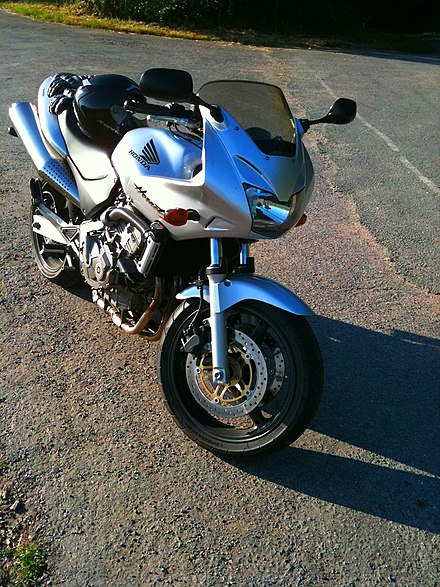
2002 Honda CB600SHonda CB600S
The Honda CB600F Hornet was introduced for Europe in 1998. It was based on the CB250F that was restricted to 250 cc (15 cu in) at its home-market (Japan) because of local laws (this bike was released only in Japan from 1996 or 1997 until 2015, when it was succeeded by the CB300F). The bike has a six-speed transmission. Its suspension consists of a single shock in the rear and a conventional telescopic fork in the front until it was succeeded by an upside-down fork in 2005. Its brakes are dual-disc, Nissin twin piston in the front and single-disc, Nissin single piston in the rear. It was given the 16 in (410 mm) diameter front wheel and 17 in (430 mm), 180 section rear wheel setup from the Fireblade.
As a sport-oriented motorcycle that provides an upright riding position, it is considered a standard or “naked bike”.
In 2000, Honda updated the Hornet, changing the 16 in (410 mm) front wheel for a 17 in (430 mm) to help corner stability and increasing the strength of the brake pass-over system on the front, making the brakes stronger. However, Honda did not increase the size of the fuel tank. A faired version, the CB600FS, was also introduced in 2000.
In 2003, Honda gave the CB600F version a make-over, with a larger fuel tank (17 L or 3.7 imp gal or 4.5 US gal as opposed to the former 16 L or 3.5 imp gal or 4.2 US gal), and ‘sharper’ styling. The CB600S faired version was discontinued.
In 2005, the instrument cluster was modernised, and more importantly, it was fitted with inverted front forks, to improve road-holding and cornering stability.
Honda took the Hornet to the United States and Canadian market beginning for the 2004 and 2006 model years respectively. It was called the 599.
The highly revised CB600F model came out in April 2007. The engine of the new motorcycle is a detuned version of the engine available in the 2007 CBR600RR giving a maximum output power of approximately 102 bhp (76 kW).
In 2011, the model got a facelift. The headlight assembly was changed and the instrument cluster uses LCD display. This bike shared many of the same components – swingarm, fork, frame, engine – as the Honda CBR600F that was reintroduced in 2011.
In November 2013, at the EICMA show, Honda debuted the all-new CB650F naked bike and CBR650F sport bike, to replace the outgoing CB600F Hornet in 2014.
In 2022, Honda announced the new Honda Hornet (CB 750 S) as the successor to the CB600F Hornet in Europe.
Specifications
1998-1999
2000-2002
2003-2004
2005-2006
2007–2013
Locations
Model ID
Europe (CB600F Hornet)
Europe (CB600F Hornet) & North America (599)
Engine
Engine Type
599 cc (36.6 cu in) liquid-cooled 4-stroke 16-valve DOHC inline-4
Bore/Stroke
65.0 mm × 45.2 mm (2.56 in × 1.78 in)
67.0 mm × 42.5 mm (2.64 in × 1.67 in)
Compression Ratio
12.0:1
Max Power Output
94.69 bhp (70.61 kW) at 12,000 rpm
94 bhp (70 kW) at 12,000 rpm
95 bhp (71 kW) at 12,000 rpm 80.4 hp (60.0 kW)(rear wheel)
The Honda 500 twins are a group of straight-twin motorcycles made by Honda since 2013 which use the same 471 cc (28.7 cu in), 180° crank, straight-twin engine, such as the:
CB500F naked bike (2013–2024)
CB500X adventure touring bike (2013–2024)
CBR500R sport bike (2013–present)
CMX500 Rebel bobber (2017–present)
SCL500/CL500 standard, “Scrambler-style” bike (2023–present)
NX500 adventure touring bike (2024–present)
CB500 Hornet naked bike (2024–present)
These models are sold in Japan with smaller capacity 399 cc engines: CB400F (2013–2016), CB400X, and CBR400R. Their introduction coincided with new European licensing regulations establishing a mid-range class of motorcycles of limited power. The new 500 twins are similar to the earlier CB500 parallel-twins discontinued in 2003, but all-new from the ground up. They are made in Thailand, where Honda had previously made only smaller displacement motorcycles.
All models use the same 471 cc (28.7 cu in) 180° crank straight-twin engine with capacity and power below the A2 European driving licence limit. They share the same six-speed gearbox and the majority of cycle parts. The CB500X has a larger fuel tank and longer front suspension travel making it taller, and with more ground clearance.
On its release, the CBR500R was the one-design model the European Junior Cup in 2013 and 2014. Since 2014, Honda has partnered with local organisers to promote national CBR500R Cup events in Brazil and France; raced over various circuits, the competitions are open to amateurs from 13-years upwards.
Model history
CBR500R 2019
The three models were announced on the eve of the November 2012 EICMA show in Milan.
2013
April: CB500F, CBR500R released; July: CB500X released
2016
EURO 4 compliance with smaller exhaust, LED headlamp, preload adjustable front suspension, smaller side covers, larger fuel tank on CB500F and CBR500R, Fireblade style fairing on the CBR500R
2019
Revised exhaust system, anti-rebound clutch, full LED lighting, revised rear shocks, new LCD instrumentation with additional features, 19″ front wheel on the ruggedized CB500X, dual-channel ABS standard on all models in most markets, although for 2017 USA models, it remained an option.
CB500F 2021
2022
Inverted Showa Separate Function Fork – Big Piston (SFF-BP) forks, dual 296mm disk with radial calipers up front, updated triple tree clamps, new fuel injection settings that further increase torque feel and overall character, other changes include a lighter swingarm, lighter radiator, revised shock settings, redesigned and lighter front wheel, more powerful LEDs. The US Market only received the Pearl Organic Green colorway for 2022.
The CB500X was released at a price of ฿224,900 (US$7,032.52) in Thailand. In Germany, the CB500X was released at €7,099 (US$8,395.99).
Reactions
Since its launch, the range received many favorable reviews; some preferring the taller X model while the sporty R model was one of Honda’s top selling bikes in Canada during 2015 and best selling sports bike in Australia. Many commentators, especially in off-road and long-distance touring, argued the need for such middleweight bikes. Perhaps as a consequence, in 2015, RallyRaid, a British after-market specialist, created upgrade kits for the R & F machines and a full adventure conversion kit for the X model.
Multiple small improvements in the 2019 range impressed commentators with MCN describing the CB500X as an exceptional machine.
Specifications
All specifications are manufacturer claimed unless otherwise specified. The motorcycle model designation is printed on a sticker under the seat.
Model
CB500F
CBR500R
CB500X
Type
Naked
Sport
Adventure
Engine
Four stroke, parallel twin, DOHC, 8 valves, liquid-cooled
Displacement
471 cc (28.7 cu in)
Bore x stroke
67.0 mm × 66.8 mm (2.64 in × 2.63 in)
Compression ratio
10.7 : 1
Fuel delivery
Honda PGM-FI via 34 mm (1.3 in) throttle bodies
Ignition
Fully transistorized with ignition advance
Maximum power
35 kW (47 hp) at 8,500 rpm
Maximum torque
43 N⋅m (32 lbf⋅ft) at 7,000 rpm
Transmission
6-speed sequential, constant mesh
Clutch
Wet, multi-plate, coil spring
Final drive
520 o-ring chain, 112 links
Frame
Tubular steel, diamond, stressed engine
Rake
25.5°
26.5° (2013–2018) 27.5° (2019-present)
Trail
102 mm (4.0 in)
108 mm (4.3 in)
Turning radius
2,700 mm (110 in)
2,800 mm (110 in) (2013–2018) 2,400 mm (94 in) (2019–present)